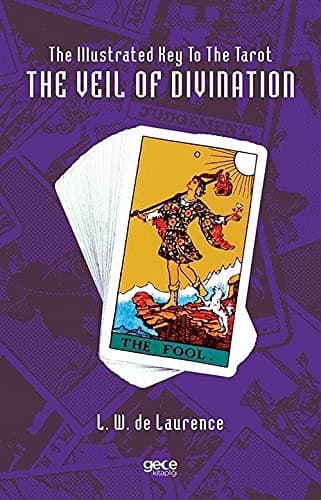
The Illustrated Key to the Tarot: The Veil of DivinationDe Laurence, L. W. (Lauron William)
Religion
The Illustrated Key to the Tarot: The Veil of Divination
De Laurence, L. W. (Lauron William)
Fortune-telling by cards; Tarot
It is certain, however, that they include Tarot Trumps Major,
the list of which is as follows: Fool, Emperor, Pope, Lovers,
Wheel of Fortune, Temperance, Fortitude, Justice, Moon, Sun,
Chariot, Hermit, Hanged Man, Death, Tower and Last Judgment.
There are also four Tarot Cards at the Musée Carrer,
Venice, and five others elsewhere, making nine in all. They
include two pages or Knaves, three Kings and two Queens, thus
illustrating the Minor Arcana. These collections have all been
identified with the set produced by Gringonneur, but the ascription
was disputed so far back as the year 1848, and it is not apparently
put forward at the present day, even by those who are anxious
to make evident the antiquity of the Tarot. It is held that they
are all of Italian and some at least certainly of Venetian origin.
We have in this manner our requisite point of departure in
respect of place at least. It has further been stated with authority
that Venetian Tarots are the old and true form, which is the
parent of all others; but I infer that complete sets of the Major
and Minor Arcana belong to much later periods. The pack is
thought to have consisted of seventy-eight cards.
Notwithstanding, however, the preference shown towards the
Venetian Tarot, it is acknowledged that some portions of a Minchiate
or Florentine set must be allocated to the period between
1413 and 1418. These were once in the possession of Countess
Gonzaga, at Milan. A complete Minchiate pack contained
ninety-seven cards, and in spite of these vestiges it is regarded,
speaking generally, as a later development. There were forty-one
Trumps Major, the additional numbers being borrowed or
reflected from the Baldini emblematic set. In the court cards of
the Minor Arcana, the Knights were monsters of the centaur
type, while the Knaves were sometimes warriors and sometimes
serving-men. Another distinction dwelt upon is the prevalence
of Christian mediæval ideas and the utter absence of any Oriental
suggestion. The question, however, remains whether there are
Eastern traces in any Tarot cards.
Public-domain text, read in full here on John Shaqi.
Reviews
Reviews
No reviews yet
Be the first to share your thoughts on this work.
Join the Discussion
Join the discussion
Sign in to leave a comment or review.
Sign InorCreate an account