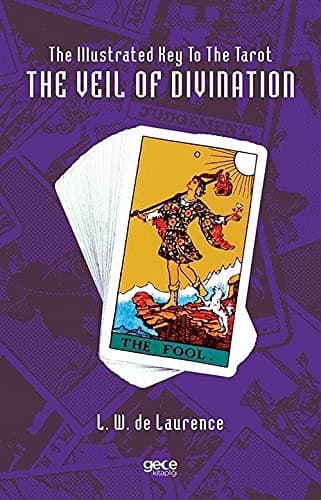
The Illustrated Key to the Tarot: The Veil of DivinationDe Laurence, L. W. (Lauron William)
Religion
The Illustrated Key to the Tarot: The Veil of Divination
De Laurence, L. W. (Lauron William)
Fortune-telling by cards; Tarot
We come, in fine, to the Bolognese Tarot, sometimes referred
to as that of Venice and having the Trumps Major complete, but
numbers 20 and 21 are transposed. In the Minor Arcana the 2,
3, 4 and 5 of the small cards are omitted, with the result that
there are sixty-two cards in all. The termination of the Trumps
Major in the representation of the Last Judgment is curious, and
a little arresting as a point of symbolism; but this is all that it
seems necessary to remark about the pack of Bologna, except that
it is said to have been invented—or, as a Tarot, more correctly,
modified—about the beginning of the fifteenth century by an
exiled Prince of Pisa resident in the city. The purpose for
which they were used is made tolerably evident by the fact that,
in 1423, St. Bernardin of Sienna preached against playing cards
and other forms of gambling. Forty years later the importation
of cards into England was forbidden, the time being that of King
Edward IV. This is the first certain record of the subject in our
country.
It is difficult to consult perfect examples of the sets enumerated
above, but it is not difficult to meet with detailed and illustrated
descriptions—I should add, provided always that the writer is not
an occultist, for accounts emanating from that source are usually
imperfect, vague and preoccupied by considerations which cloud
the critical issues. An instance in point is offered by certain
views which have been expressed on the Mantegna codex—if I
may continue to dignify card sequences with a title of this kind.
It has been ruled—as we have seen—in occult reverie that Apollo
and the Nine Muses are in correspondence with Pentacles, but the
analogy does not obtain in a working state of research; and
reverie must border on nightmare before we can identify Astronomy,
Chronology and Cosmology with the suit of Cups. The
Baldini figures which represent these subjects are emblems of
their period and not symbols, like the Tarot.
In conclusion as to this part, I observe that there has been a
disposition among experts to think that the Trumps Major were
not originally connected with the numbered suits. I do not wish
to offer a personal view; I am not an expert in the history of
games of chance, and I hate the profanum vulgus of divinatory
devices; but I venture, under all reserves, to intimate that if later
research should justify such a leaning, then—except for the good
old art of fortune-telling and its tamperings with so-called destiny—it
will be so much the better for the Greater Arcana.
Public-domain text, read in full here on John Shaqi.
Reviews
Reviews
No reviews yet
Be the first to share your thoughts on this work.
Join the Discussion
Join the discussion
Sign in to leave a comment or review.
Sign InorCreate an account