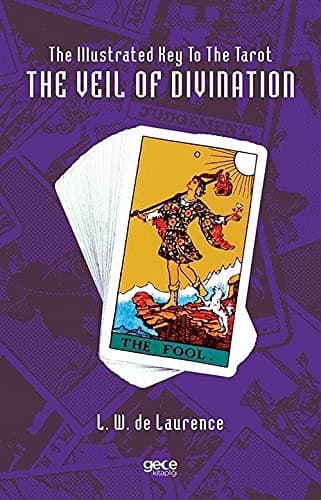
The Illustrated Key to the Tarot: The Veil of DivinationDe Laurence, L. W. (Lauron William)
Religion
The Illustrated Key to the Tarot: The Veil of Divination
De Laurence, L. W. (Lauron William)
Fortune-telling by cards; Tarot
4. The Emperor, by imputation the spouse of the former. He
is occasionally represented as wearing, in addition to his personal
insignia, the stars or ribbons of some order of chivalry.
I mention this to show that the cards are a medley of old and
new emblems. Those who insist upon the evidence of the one
may deal, if they can, with the other. No effectual argument
for the antiquity of a particular design can be drawn from the
fact that it incorporates old material; but there is also none
which can be based on sporadic novelties, the intervention of
which may signify only the unintelligent hand of an editor or of
a late draughtsman.
5. The High Priest or Hierophant, called also Spiritual Father,
and more commonly and obviously the Pope. It seems even to
have been named the Abbot, and then its correspondence, the
High Priestess, was the Abbess or Mother of the Convent.
Both are arbitrary names. The insignia of the figures are papal,
and in such case the High Priestess is and can be only the Church,
to whom Pope and priests are married by the spiritual rite of
ordination. I think, however, that in its primitive form this card
did not represent the Roman Pontiff.
6. The Lovers or Marriage. This symbol has undergone many
variations, as might be expected from its subject. In the
eighteenth century form, by which it first became known to the
world of archæological research, it is really a card of married
life, showing father and mother, with their child placed between
them; and the pagan Cupid above, in the act of flying his shaft,
is, of course, a misapplied emblem. The Cupid is of love beginning
rather than of love in its fulness, guarding the fruit thereof.
The card is said to have been entitled Simulacrum fidei, the
symbol of conjugal faith, for which the rainbow as a sign of the
covenant would have been a more appropriate concomitant. The
figures are also held to have signified Truth, Honor and Love,
but I suspect that this was, so to speak, the gloss of a commentator
moralizing. It has these, but it has other and higher
aspects.
7. The Chariot. This is represented in some extant codices
as being drawn by two sphinxes, and the device is in consonance
with the symbolism, but it must not be supposed that such was its
original form; the variation was invented to support a particular
historical hypothesis. In the eighteenth century white horses
were yoked to the car. As regards its usual name, the lesser
stands for the greater; it is really the King in his triumph, typifying,
however, the victory which creates kingship as its natural
consequence and not the vested royalty of the fourth card. M.
Court de Gebelin said that it was Osiris Triumphing, the conquering
sun in spring-time having vanquished the obstacles of
winter. We know now that Osiris rising from the dead is not
represented by such obvious symbolism. Other animals than
horses have also been used to draw the currus triumphalis, as, for
example, a lion and a leopard.
Public-domain text, read in full here on John Shaqi.
Reviews
Reviews
No reviews yet
Be the first to share your thoughts on this work.
Join the Discussion
Join the discussion
Sign in to leave a comment or review.
Sign InorCreate an account