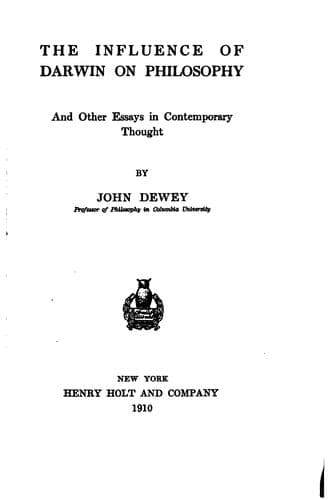
The Influence of Darwin on Philosophy, and other essays in contemporary thoughtDewey, John
Philosophy
The Influence of Darwin on Philosophy, and other essays in contemporary thought
Dewey, John
Evolution; Philosophy; Pragmatism
The displacing of this wholesale type of philosophy will doubtless not
arrive by sheer logical disproof, but rather by growing recognition
of its futility. Were it a thousand times true that opium produces
sleep because of its dormitive energy, yet the inducing of sleep in
the tired, and the recovery to waking life of the poisoned, would not
be thereby one least step forwarded. And were it a thousand times
dialectically demonstrated that life as a whole is regulated by a
transcendent principle to a final inclusive goal, none the less truth
and error, health and disease, good and evil, hope and fear in the
concrete, would remain just what and where they now are. To improve our
education, to ameliorate our manners, to advance our politics, we must
have recourse to specific conditions of generation.
Finally, the new logic introduces responsibility into the intellectual
life. To idealize and rationalize the universe at large is after
all a confession of inability to master the courses of things that
specifically concern us. As long as mankind suffered from this
impotency, it naturally shifted a burden of responsibility that
it could not carry over to the more competent shoulders of the
transcendent cause. But if insight into specific conditions of value
and into specific consequences of ideas is possible, philosophy must
in time become a method of locating and interpreting the more serious
of the conflicts that occur in life, and a method of projecting ways
for dealing with them: a method of moral and political diagnosis and
prognosis.
The claim to formulate _a priori_ the legislative constitution of the
universe is by its nature a claim that may lead to elaborate dialectic
developments. But it is also one that removes these very conclusions
from subjection to experimental test, for, by definition, these results
make no differences in the detailed course of events. But a philosophy
that humbles its pretensions to the work of projecting hypotheses for
the education and conduct of mind, individual and social, is thereby
subjected to test by the way in which the ideas it propounds work out
in practice. In having modesty forced upon it, philosophy also acquires
responsibility.
Public-domain text, read in full here on John Shaqi.
Reviews
Reviews
No reviews yet
Be the first to share your thoughts on this work.
Join the Discussion
Join the discussion
Sign in to leave a comment or review.
Sign InorCreate an account