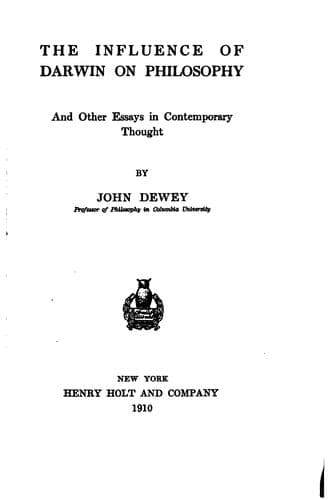
The Influence of Darwin on Philosophy, and other essays in contemporary thought — John Shaqi
The Influence of Darwin on Philosophy, and other essays in contemporary thoughtDewey, John
Philosophy
The Influence of Darwin on Philosophy, and other essays in contemporary thought
Dewey, John
Evolution; Philosophy; Pragmatism
Doubtless I seem to have violated the implied promise of my earlier
remarks and to have turned both prophet and partizan. But in
anticipating the direction of the transformations in philosophy to
be wrought by the Darwinian genetic and experimental logic, I do not
profess to speak for any save those who yield themselves consciously
or unconsciously to this logic. No one can fairly deny that at present
there are two effects of the Darwinian mode of thinking. On the one
hand, there are making many sincere and vital efforts to revise our
traditional philosophic conceptions in accordance with its demands. On
the other hand, there is as definitely a recrudescence of absolutistic
philosophies; an assertion of a type of philosophic knowing distinct
from that of the sciences, one which opens to us another kind of
reality from that to which the sciences give access; an appeal through
experience to something that essentially goes beyond experience. This
reaction affects popular creeds and religious movements as well as
technical philosophies. The very conquest of the biological sciences by
the new ideas has led many to proclaim an explicit and rigid separation
of philosophy from science.
Old ideas give way slowly; for they are more than abstract
logical forms and categories. They are habits, predispositions,
deeply engrained attitudes of aversion and preference. Moreover,
the conviction persists--though history shows it to be a
hallucination--that all the questions that the human mind has asked
are questions that can be answered in terms of the alternatives that
the questions themselves present. But in fact intellectual progress
usually occurs through sheer abandonment of questions together with
both of the alternatives they assume--an abandonment that results from
their decreasing vitality and a change of urgent interest. We do not
solve them: we get over them. Old questions are solved by disappearing,
evaporating, while new questions corresponding to the changed attitude
of endeavor and preference take their place. Doubtless the greatest
dissolvent in contemporary thought of old questions, the greatest
precipitant of new methods, new intentions, new problems, is the one
effected by the scientific revolution that found its climax in the
“Origin of Species.”
NATURE AND ITS GOOD: A CONVERSATION[5]
A group of people are scattered near one another, on the sands of an
ocean beach; wraps, baskets, etc., testify to a day’s outing. Above the
hum of the varied conversations are heard the mock sobs of one of the
party.
_Various voices._ What’s the matter, Eaton?
_Eaton._ Matter enough. I was watching a beautiful wave; its lines were
perfect; at its crest, the light glinting through its infinitely varied
and delicate curves of foam made a picture more ravishing than any
dream. And now it has gone; it will never come back. So I weep.
Public-domain text, read in full here on John Shaqi.
Reviews
Reviews
No reviews yet
Be the first to share your thoughts on this work.
Join the Discussion
Join the discussion
Sign in to leave a comment or review.
Sign InorCreate an account