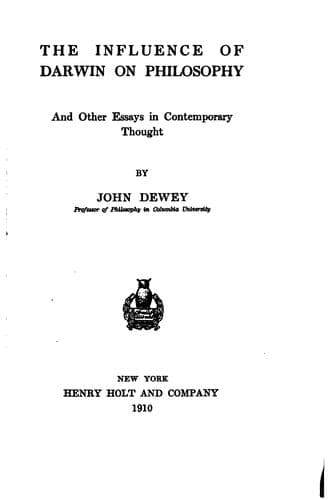
The Influence of Darwin on Philosophy, and other essays in contemporary thoughtDewey, John
Philosophy
The Influence of Darwin on Philosophy, and other essays in contemporary thought
Dewey, John
Evolution; Philosophy; Pragmatism
For in an experience where values
are demonstrably precarious, an intelligence that is not a principle
of emphasis and valuation (an intelligence which defines, describes,
and classifies merely for the sake of knowledge,) is a principle of
stupidity and catastrophe.
As for Grimes, it is indeed true that problems are solved only where
they arise--namely, in action, in the adjustments of behavior. But,
for good or for evil, they can be solved there only with method; and
ultimately method is intelligence, and intelligence is method. The
larger, the more human, the less technical the problem of practice,
the more open-eyed and wide-viewing must be the corresponding method.
I do not say that all things that have been called philosophy
participate in this method; I do say, however, that a catholic and
far-sighted theory of the adjustment of the conflicting factors of
life _is_--whatever it be called--philosophy. And unless technical
philosophy is to go the way of dogmatic theology, it must loyally
identify itself with such a view of its own aim and destiny.
INTELLIGENCE AND MORALS[6]
“Except the blind forces of nature,” said Sir Henry Maine, “nothing
moves in this world which is not Greek in its origin.” And if we ask
why this is so, the response comes that the Greek discovered the
business of man to be pursuit of good, and intelligence to be central
in this quest. The utmost to be said in praise of Plato and Aristotle
is not that they invented excellent moral theories, but that they rose
to the opportunity which the spectacle of Greek life afforded. For
Athens presented an all but complete microcosm for the study of the
interaction of social organization and individual character. A public
life of rich diversity in concentrated and intense splendor trained
the civic sense. Strife of faction and the rapid oscillations of types
of polity provided the occasion for intellectual inquiry and analysis.
The careers of dramatic personalities, habits of discussion, ease of
legislative change, facilities for personal ambitions, distraction by
personal rivalries, fixed attention upon the elements of character,
and upon consideration of the effect of individual character on
social vitality and stability. Happy exemption from ecclesiastic
preoccupations, susceptibility to natural harmony, and natural piety
conspired with frank and open observation to acknowledgment of the rôle
played by natural conditions. Social instability and shock made equally
pertinent and obvious the remark that only intelligence can confirm
the values that natural conditions generate, and that intelligence is
itself nurtured and matured only in a free and stable society.
Public-domain text, read in full here on John Shaqi.
Reviews
Reviews
No reviews yet
Be the first to share your thoughts on this work.
Join the Discussion
Join the discussion
Sign in to leave a comment or review.
Sign InorCreate an account