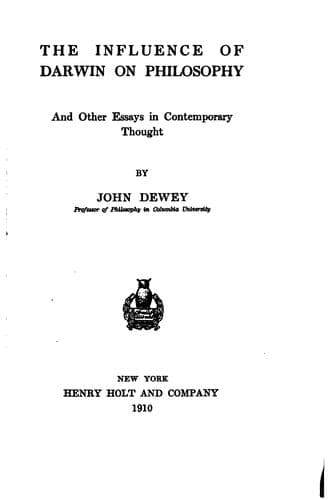
The Influence of Darwin on Philosophy, and other essays in contemporary thought — John Shaqi
The Influence of Darwin on Philosophy, and other essays in contemporary thoughtDewey, John
Philosophy
The Influence of Darwin on Philosophy, and other essays in contemporary thought
Dewey, John
Evolution; Philosophy; Pragmatism
In Plato the resultant analysis of the mutual implications of the
individual, the social and the natural, converged in the ideas that
morals and philosophy are one: namely, a love of that wisdom which
is the source of secure and social good; that mathematics and the
natural sciences focused upon the problem of the perception of the good
furnish the materials of moral science; that logic is the method of the
pregnant organization of social conditions with respect to good; that
politics and psychology are sciences of one and the same human nature,
taken first in the large and then in the little. So far that large and
expansive vision of Plato.
But projection of a better life must be based upon reflection of the
life already lived. The inevitable limitations of the Greek city-state
were inevitably wrought into the texture of moral theory.
The business of thought was to furnish a substitute for customs which
were then relaxing from the pressure of contact and intercourse without
and the friction of strife within. Reason was to take the place of
custom as a guide of life; but it was to furnish rules as final, as
unalterable as those of custom. In short, the thinkers were fascinated
by the afterglow of custom. They took for their own ideal the
distillation from custom of its essence--ends and laws which should be
rigid and invariable. Thus Morals was set upon the track which it dared
not leave for nigh twenty-five hundred years: search for _the_ final
good, and for _the_ single moral force.
Aristotle’s assertions that the state exists by nature, and that in the
state alone does the individual achieve independence and completeness
of life, are indeed pregnant sayings. But as uttered by Aristotle they
meant that, in an isolated state, the Greek city-state, set a garlanded
island in the waste sea of _barbaroi_, a community indifferent when not
hostile to all other social groupings, individuals attain their full
end. In a social unity which signified social contraction, contempt,
and antagonism, in a social order which despised intercourse and
glorified war, is realized the life of excellence!
Public-domain text, read in full here on John Shaqi.
Reviews
Reviews
No reviews yet
Be the first to share your thoughts on this work.
Join the Discussion
Join the discussion
Sign in to leave a comment or review.
Sign InorCreate an account