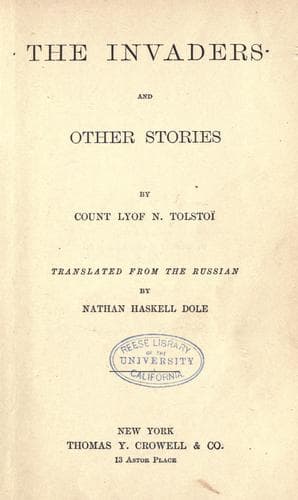
Russian fiction -- Translations into English; Short stories, Russian -- Translations into English
Velenchúk came under the head of the energetically obedient. He was a
Little Russian by birth, had been fifteen years in the service; and
while he was not a fine-looking nor a very skilful soldier, still he
was simple-hearted, kind, and extraordinarily full of zeal, though
for the most part misdirected zeal, and he was extraordinarily honest.
I say extraordinarily honest, because the year before there had been
an occurrence in which he had given a remarkable exhibition of this
characteristic. You must know that almost every soldier has his own
trade. The greater number are tailors and shoemakers. Velenchúk
himself practised the trade of tailoring; and, judging from the fact
that Sergeant Mikháil Doroféïtch gave him his custom, it is safe to
say that he had reached a famous degree of accomplishment. The year
before, it happened that while in camp, Velenchúk took a fine cloak
to make for Mikháil Doroféïtch. But that very night, after he had cut
the cloth, and stitched on the trimmings, and put it under his pillow
in his tent, a misfortune befell him: the cloth, which was worth seven
rubles, disappeared during the night. Velenchúk with tears in his eyes,
with pale quivering lips and with stifled lamentations, confessed the
circumstance to the sergeant.
Mikháil Doroféïtch fell into a passion. In the first moment of his
indignation he threatened the tailor; but afterwards, like a kindly
man with plenty of means, he waved his hand, and did not exact from
Velenchúk the value of the cloak. In spite of the fussy tailor's
endeavors, and the tears that he shed while telling about his
misfortune, the thief was not detected. Although strong suspicions
were attached to a corruptly desperate soldier named Chernof, who
slept in the same tent with him, still there was no decisive proof.
The diplomatically dictatorial Mikháil Doroféïtch, as a man of means,
having various arrangements with the inspector of arms and steward of
the mess, the aristocrats of the battery, quickly forgot all about
the loss of this particular cloak. Velenchúk, on the contrary, did not
forget his unhappiness. The soldiers declared that at this time they
were apprehensive about him, lest he should make way with himself, or
flee to the mountains, so heavily did his misfortune weigh upon him. He
did not eat, he did not drink, was not able to work, and wept all the
time. At the end of three days he appeared before Mikháil Doroféïtch,
and without any color in his face, and with a trembling hand, drew out
of his sleeve a piece of gold, and gave it to him.
"Faith,[3] and here's all that I have, Mikháil Doroféïtch; and this I
got from Zhdánof," he said, beginning to sob again. "I will give _you_
two more rubles, truly I will, when I have earned them. He (who the
_he_ was, Velenchúk himself did not know) made me seem like a rascal in
your eyes. He, the beastly viper, stole from a brother soldier his hard
earnings; and here I have been in the service fifteen years." ...
Public-domain text, read in full here on John Shaqi.
Reviews
Reviews
No reviews yet
Be the first to share your thoughts on this work.
Join the Discussion
Join the discussion
Sign in to leave a comment or review.
Sign InorCreate an account