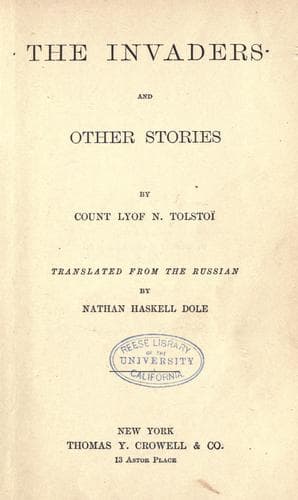
Russian fiction -- Translations into English; Short stories, Russian -- Translations into English
To the honor of Mikháil Doroféïtch, it must be said that he did not
require of Velenchúk the last two rubles, though Velenchúk brought them
to him at the end of two months.
[Footnote 3: _yéï Bogu._]
III.
Five other soldiers of my platoon besides Velenchúk were warming
themselves around the bonfire.
In the best place, away from the wind, on a cask, sat the platoon
artillerist[4] Maksímof, smoking his pipe. In the posture, the gaze,
and all the motions of this man it could be seen that he was accustomed
to command, and was conscious of his own worth, even if nothing were
said about the cask whereon he sat, which during the halt seemed to
become the emblem of power, or the nankeen short-coat which he wore.
When I approached, he turned his head round toward me; but his eyes
remained fixed upon the fire, and only after some time did they follow
the direction of his face, and rest upon me. Maksímof came from a
semi-noble family.[5] He had property, and in the school brigade he
obtained rank, and acquired some learning. According to the reports of
the soldiers, he was fearfully rich and fearfully learned.
I remember how one time, when they were making practical experiments
with the quadrant, he explained, to the soldiers gathered around him,
that the motions of the spirit level arise from the same causes as
those of the atmospheric quicksilver. At bottom Maksímof was far from
stupid, and knew his business admirably; but he had the bad habit of
speaking, sometimes on purpose, in such a way that it was impossible
to understand him, and I think he did not understand his own words.
He had an especial fondness for the words "arises" and "to proceed;"
and whenever he said "it arises," or "now let us proceed," then I
knew in advance that I should not understand what would follow. The
soldiers, on the contrary, as I had a chance to observe, enjoyed
hearing his "arises," and suspected it of containing deep meaning,
though, like myself, they could not understand his words. But this
incomprehensibility they ascribed to his depth, and they worshipped
Feódor Maksímuitch accordingly. In a word, Maksímof was diplomatically
dictatorial.
The second soldier near the fire, engaged in drawing on his sinewy
red legs a fresh pair of stockings, was Antónof, the same bombardier
Antónof who as early as 1837, together with two others stationed by one
gun without shelter, was returning the shot of the enemy, and with two
bullets in his thigh continued still to serve his gun and load it.
Public-domain text, read in full here on John Shaqi.
Reviews
Reviews
No reviews yet
Be the first to share your thoughts on this work.
Join the Discussion
Join the discussion
Sign in to leave a comment or review.
Sign InorCreate an account