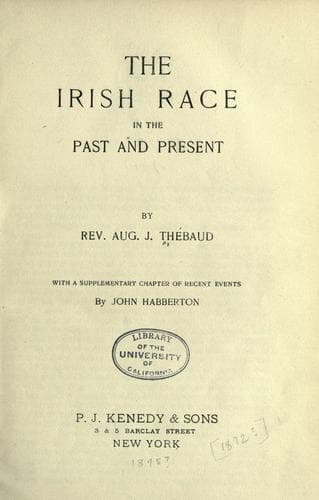
The Irish Race in the Past and the Present — John Shaqi
The Irish Race in the Past and the PresentThébaud, Augustus J.
History
The Irish Race in the Past and the Present
Thébaud, Augustus J.
Ireland -- History
In each of those great primitive stocks, an all-wise Providence
introduced a large number of sub-races, if we may be allowed to
call them so, out of which are sprung the various nations whose
intermingling forms the web of human history. Our object is to
consider only the Celtic branch. For, whatever may be the various
theories propounded on the subject of the colonization of Ireland,
from whatever part of the globe the primitive inhabitants may be
supposed to have come, one thing is certain, to-day the race is
yet one, in spite of the foreign blood infused into it by so many
men of other stocks. Although the race was at one time on the verge
of extinction by Cromwell, it has finally absorbed all the others;
it has conquered; and, whoever has to deal with true Irishmen, feels
at once that he deals with a primitive people, whose ancestors dwelt
on the island thousands of years ago. Some slight differences may
be observed in the people of the various provinces of the island;
there maybe various dialects in their language, different appearance
in their looks, some slight divergence in their disposition or manners;
it cannot be other wise, since, as we have seen, no two individuals
of the human family can be found perfectly alike. But, in spite
of all this, they remain Celts to this day; they belong undoubtedly,
to that stock formerly wide-spread throughout Europe, and now almost
confined to their island; for the character of the same race in
Wales, Scotland, and Brittany, has not been, and could not be,
kept so pure as in Erin; so that in our age the inhabitants of
those countries have become more and more fused with their British
and Gallic neighbors.
We must, therefore, at the beginning of this investigation, state
briefly what we know of the Celtic race in ancient times, and examine
whether the Irish of to-day do not reproduce its chief characteristics.
We do not propose, however, in the present study, referring to
the physical peculiarities of the Celtic tribes; we do not know
what those were two or three thousand years ago. We must confine
ourselves to moral propensities and to manners, and for this view
of the subject we have sufficient materials whereon to draw.
We first remark in this race an immense power of expansion, when
not checked by truly insurmountable obstacles; a power of expansion
which did not necessitate for its workings an uninhabited and wild
territory, but which could show its energy and make its force felt
in the midst of already thickly-settled regions, and among adverse
and warlike nations.
Public-domain text, read in full here on John Shaqi.
Reviews
Reviews
No reviews yet
Be the first to share your thoughts on this work.
Join the Discussion
Join the discussion
Sign in to leave a comment or review.
Sign InorCreate an account