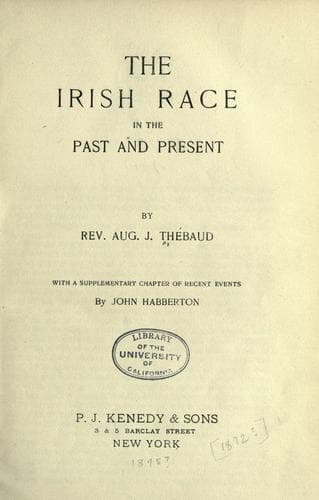
The Irish Race in the Past and the PresentThébaud, Augustus J.
History
The Irish Race in the Past and the Present
Thébaud, Augustus J.
Ireland -- History
At first sight, the dignity of supreme monarch would almost seem
to be a sinecure under the clan system, as the authority attached
to it was extremely limited, and is generally compared in its
relations to the subordinate kings, as that of metropolitan to
suffragan bishops in the Church. Nevertheless, all Celtic nations
appear to have attached a great importance to it, and the real
misfortunes of Ireland began when contention ran so high for the
office that the people were divided in their supreme allegiance,
and no Ard-Righ was acknowledged at the same time by all; which
happened precisely at the period of the invasion under Strongbow.
Some few facts lately brought to light in the vicissitudes of
various branches of the Celtic family show at once how highly all
Celts, wherever they might be settled, esteemed the dignity of
supreme monarch. It existed, as we have said, in all Celtic
countries, and consequently in Gaul; and the passage in the
"Commentaries" of Julius Caesar on the subject is too important
to be entirely passed over.
After having remarked in the eleventh chapter, "De Bello Gallico,"
lib. vi., that in Gaul the whole country, each city or clan, and
every subdivision of it, even to single houses, presented the
strange spectacle of two parties, "factiones," always in presence
of and opposed to each other, he says in Chapter XII.: --at the
arrival of Caesar in Gaul the _Eduans_ and the _Sequanians_ were
contending for the supreme authority--"The latter civitas--clan--
namely, the Sequanians, being inferior in power--because from
time immemorial the supreme authority had been vested in the
Eduans--had called to its aid the Germans under Ariovist by the
inducement of great advantages and promises. After many successful
battles, in which the entire nobility of the Eduan clan perished,
the Sequanians acquired so much power that they rallied to
themselves the greatest number of the allies of their rivals,
obliged the Eduans to give as hostages the children of their
nobles who had perished, to swear that they would not attempt
any thing against their conquerors, and even took possession of
a part of their territory, and thus obtained the supreme command
of all Gaul."
We see by this passage that there was a supremacy resting in the
hands of some one, over the whole nation. The successful tribe
had a chief to whom that supremacy belonged. Caesar, it is true,
does not speak of a monarch as of a person, but attributes the
power to the "civitas," the tribe. It is well known, however,
that each tribe had a head, and that in Celtic countries the
power was never vested in a body of men, assembly, committee, or
board, as we say in modern times, but in the chieftain, whatever
may have been his degree.
Public-domain text, read in full here on John Shaqi.
Reviews
Reviews
No reviews yet
Be the first to share your thoughts on this work.
Join the Discussion
Join the discussion
Sign in to leave a comment or review.
Sign InorCreate an account