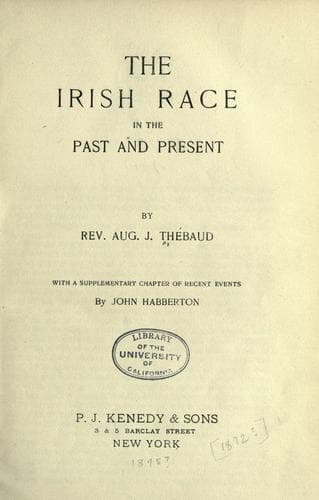
The Irish Race in the Past and the PresentThébaud, Augustus J.
History
The Irish Race in the Past and the Present
Thébaud, Augustus J.
Ireland -- History
The author of the "Commentaries" was a Roman in whose eyes the
state was every thing, the actual office-holder, dictator, consul,
or praetor, a mere instrument for a short time; and he was too apt,
like most of his countrymen, to judge of other nations by his own.
We may conclude from the passage quoted that there was a supreme
monarch in Gaul as well as in Ireland, and modern historians of
Gaul have acknowledged it.
But there is yet a stranger fact, which absolutely cannot be
explained, save on the supposition that the Celts everywhere held
the supreme dignity of extreme if not absolute importance in their
political system.
To give it the preeminence it deserves, we must refer to a subsequent
event in the history of the Celts in Britain, since it happened
there several centuries after Caesar, and we will quote the words
of Augustin Thierry, who relates it:
"After the retreat of the legions, recalled to Italy to protect
the centre of the empire and Rome itself against the invasion
of the Goths, the Britons ceased to acknowledge the power of the
foreign governors set over their provinces and cities. The forms,
the offices, the very spirit and language of the Roman administration
disappeared; in their place was reconstituted the traditional
authority of the clannish chieftains formerly abolished by Roman
power. Ancient genealogies carefully preserved by the poets,
called in the British language _bairdd_ - bards - helped to discover
those who could pretend to the dignity of chieftains of tribes
or families, tribe and family being synonymous in their language;
and the ties of relationship formed the basis of their social
state. Men of the lowest class, among that people, preserved in
memory the long line of their ancestry with a care scarcely known
to other nations, among the highest lords and princes. All the
British Celts, poor or rich, had to establish their genealogy in
order fully to enjoy their civil rights and secure their claim of
property in the territory of the tribe. The whole belonging to a
primitive family, no one could lay any claim to the soil, unless his
relationship was well established.
"At the top of this social order, composing a federation of small
hereditary sovereignties, the Britons, freed from Roman power,
constituted a high national sovereignty; they created a chieftain
of chieftains, in their tongue called _Penteyrn_, that is to say,
a _king of the whole_, in the language of their old annals. And
they made him elective.--It was also formerly the custom in Gaul.
--The object was to introduce into their system a kind of
centralization, which, however, was always loose among Celtic
tribes."--(_Conquete de l'Angleterre_, liv. i.)
Public-domain text, read in full here on John Shaqi.
Reviews
Reviews
No reviews yet
Be the first to share your thoughts on this work.
Join the Discussion
Join the discussion
Sign in to leave a comment or review.
Sign InorCreate an account