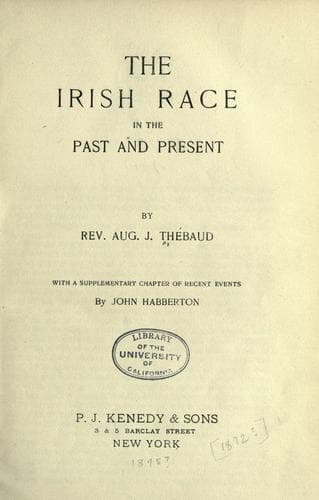
The Irish Race in the Past and the PresentThébaud, Augustus J.
History
The Irish Race in the Past and the Present
Thébaud, Augustus J.
Ireland -- History
It is evident to us that if the Britons _constituted_ a supreme
power, when freed from the Roman yoke, it was only because they
had possessed it before they became subject to that yoke. It is,
therefore, safe to conclude that there was a supreme monarch in
Britain and in Gaul as well as in Ireland; and since the Britons,
after having lost for several centuries their autonomy of government,
thought of reestablishing this supreme authority as soon as they
were free to do so, it is clear that they attached a real
importance to it, and that it entered as an essential element
into the social fabric.
But what in reality was the authority of the Ard-Righ in Ireland,
of the Penteyrn in Britain, of the supreme chief in Gaul, whose
name, as usual, is not mentioned by Caesar?
First, it is to be remarked that a certain extent of territory was
always under his immediate authority. Then, as far as we can gather
from history, there was a reciprocity of obligations between the
high power and the subordinate kings or chieftains, the former
granting subsidies to the latter, who in turn paid tribute to
support the munificence or military power of the former.
We know from the Irish annals that the dignity of Ard-Righ was
always sustained by alliances with some of the provincial kings,
to secure the submission of others, and we have a hint of the
same nature in the passage, already quoted, from Caesar, as also
taking place in Gaul.
We know also from the "Book of Rights" that the tributes and stipends
consisted of bondsmen, silver shields, embroidered cloaks, cattle,
weapons, corn, victuals, or any other contribution.
The Ard-Righ, moreover, convened the _Feis_, or general assembly
of the nation, every third year; first at Tara, and after Tara
was left to go to ruin in consequence of the curse of St. Ruadhan
in the sixth century, wherever the supreme monarch established
his residence.
The order of succession to the supreme power was the weakest point
of the Irish constitution, and became the cause of by far the
greatest portion of the nation's calamities. Theoretically the
eldest son--some say the eldest relative--of the monarch succeeded
him, when he had no blemish constituting a radical defect: the
supreme power, however, alternating in two families. To secure
the succession, the heir-apparent was always declared during the
life of the supreme king; but this constitutional arrangement
caused, perhaps, more crimes and wars than any other social
institution among the Celts. The truth is that, after the
heir-apparent, sustained by some provincial king, supplanted the
reigning monarch, one of the provincial chieftains claimed the
crown and succeeded to it by violence.
Public-domain text, read in full here on John Shaqi.
Reviews
Reviews
No reviews yet
Be the first to share your thoughts on this work.
Join the Discussion
Join the discussion
Sign in to leave a comment or review.
Sign InorCreate an account