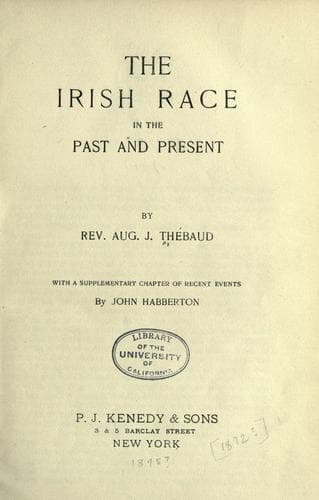
The Irish Race in the Past and the PresentThébaud, Augustus J.
History
The Irish Race in the Past and the Present
Thébaud, Augustus J.
Ireland -- History
Yet the general rule that the monarch was to belong to the race
of Miledh was adhered to almost without exception. One hundred
and eighteen sovereigns, according to the moat accredited annals,
governed the whole island from the Milesian conquest to St. Patrick
in 432. Of these, sixty were of the family of Heremon, settled
in the northern part of the island; twenty-nine of the posterity
of Heber, settled in the south; twenty-four of that of Ir; three
issued from Lugaid, the son of Ith. All these were of the race of
Miledh; one only was a _firbolg_, or plebeian, and one a woman.
It is certainly very remarkable that for so long a time--nearly
two thousand years, according to the best chronologists--Ireland
was ruled by princes of the same family. The fact is unparalleled
in history, and shows that the people were firmly attached to their
constitution, such as it was. It extorted the admiration of Sir
John Davies, the attorney-general of James I, and later of Lord Coke.
The functions of the provincial kings of Ulster, Munster,
Leinster, and Connaught, were in their several districts the same
as those which the Ard-Righ exercised over the whole country. They
also had their feuds and alliances with the inferior chieftains,
and in peaceful times there was also a reciprocity of obligations
between them. Presents were given by the superiors, tributes by
the inferiors; deliberations in assembly, mutual agreement for
public defence, wars against a common enemy, produced among them
traditional rules which were generally followed, or occasional
dissensions.
Sometimes a province had two kings, chiefly Munster, which
was often divided into north and south. Each king had his
heir-apparent, the same as the monarch. Indeed, every hereditary
office had, besides its actual holder, its Tanist, with right of
succession. Hence causes of division and feuds were needlessly
multiplied; yet all the Celtic tribes adhered tenaciously to all
those institutions which appeared rooted in their very nature, and
which contributed to foster the traditional spirit among them.
For these various offices and their inherent rights were all
derived from the universally prevailing family or clannish
disposition. Genealogies and traditions ruled the whole, and gave,
as we have seen, to their learned men a most important part and
function in the social state; and thus what the Greek and Latin
authors, Julius Caesar principally, have told us of the Celtic
Druids, is literally true of the ollamhs in their various degrees.
Public-domain text, read in full here on John Shaqi.
Reviews
Reviews
No reviews yet
Be the first to share your thoughts on this work.
Join the Discussion
Join the discussion
Sign in to leave a comment or review.
Sign InorCreate an account