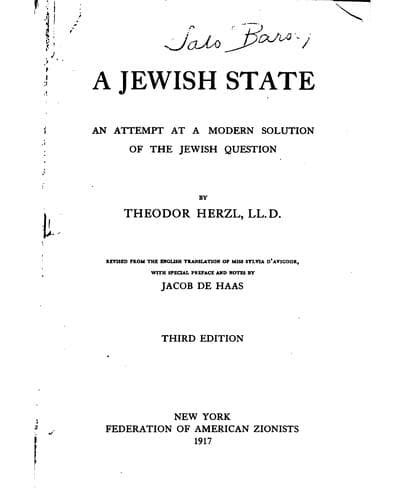
Herzl, Theodor, 1860-1904; Zionism; Zionists -- Austria -- Biography
In that fateful moment, when he heard the howling of the mob outside
the gates of the _Ecole Militaire_, the realization flashed upon Herzl
that anti-Semitism was deep-rooted in the heart of the people--so
deep, indeed, that it was impossible to hope for its disappearance
within a measurable period of time. Precisely because he was so
sensitive to his honor as a Jew, precisely because he had proclaimed,
in the _New Ghetto_, the ideal of human reconciliation, and had taken
the ultimate decision to stand by his Jewishness, the ghastly
spectacle of that winter morning must have shaken him to the depths of
his being. It was as if the ground had been cut away from under his
feet. In this sense Herzl could say later that the Dreyfus affair had
made him a Zionist.
He saw all about him the ever fiercer light of a blazing
anti-Semitism. In the French Chamber of Deputies the deputy Denis made
an interpellation on the influence of the Jews in the political
administration of the country. In Vienna a Jewish member of the
Reichstag rose to speak and was howled down. On April 2, 1895, were
held the municipal elections of Vienna, and there was an enormous
increase in the number of anti-Semitic aldermen. Changing plans passed
tumultuously through his mind. He wanted to write a book on "The
Condition of the Jews," consisting of reports on all the important
Jewish colonization enterprises in Russia, Galicia, Hungary, Bohemia,
the Orient, and those more recently founded in Palestine, about which
he had heard from a relative. Alphonse Daudet, the famous French
author with whom he had discussed the whole matter, felt that Herzl
ought to write a novel; it would carry further than a play. "Look at
_Uncle Tom's Cabin_."
He returned to his former plan of a Jewish novel which he had
abandoned when he was called to his assignment on the _Neue Freie
Presse_ in Paris. His friend Kana, the suicide, was no longer to be
the central figure. He was instead to be "the weaker one, the beloved
friend of the hero," and would take his own life after a series of
misfortunes, while the Promised Land was being discovered or rather
founded. When the hero aboard the ship which was taking him to the
Promised Land would receive the moving farewell letter of his friend,
his first reaction after his horror would be one of rage: "Idiot!
Fool! Miserable hopeless weakling! A life lost which belonged to us!"
We can see the Zionist idea arising. Its outlines are still
indefinite, but the decisive idea is clearly visible; only by
migration can this upright human type be given its chance to emerge.
In _The New Ghetto_ Jacob Samuel is a hero because he knows how to
choose an honorable death. Now the death of a useful man is criminally
wasteful. For there are great tasks to be undertaken.
Public-domain text, read in full here on John Shaqi.
Reviews
Reviews
No reviews yet
Be the first to share your thoughts on this work.
Join the Discussion
Join the discussion
Sign in to leave a comment or review.
Sign InorCreate an account