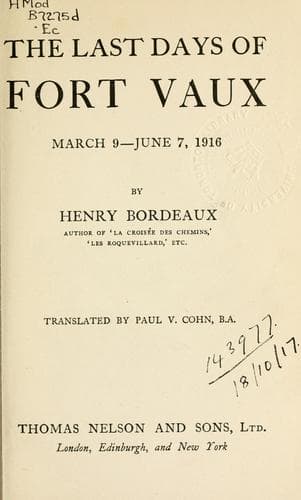
The Last Days of Fort Vaux, March 9-June 7, 1916Bordeaux, Henry
History
The Last Days of Fort Vaux, March 9-June 7, 1916
Bordeaux, Henry
Verdun, Battle of, Verdun, France, 1916; World War, 1914-1918 -- Personal narratives
None of them of his own accord makes any allusion to his recent
experiences: merely a word or two here and there, which cannot be
understood save by those who have been through the mill. Later on,
at home, or in some other theatre of war, when the events are really
buried in the past, they will tell the story after their own fashion.
Nor will they hesitate to weave into the tale other episodes drawn from
earlier or later combats. For the moment they content themselves with
saying that Verdun beats everything--the Argonne, Artois, Champagne,
Ailly Wood, Le Prêtre Wood. These comparisons by men who know give a
correct order of merit. They find no satisfaction in raking up what
is past and done with, except to say that the Boches will not break
through, in spite of their confounded heavy artillery. They revel in
the joy of living quietly and without danger. They are almost inclined
to pinch themselves so as to make sure that they are still alive. The
nightmare visions that haunt them yet might leave them in doubt on the
point. One must associate for a long time with officers and men in
order to unravel the truth little by little and reconstruct the earlier
Vaux engagements.
Properly speaking, there were no earlier Vaux engagements. The series
of operations forms an unbroken chain. Masters of Douaumont on
February 25, the Germans at once tried to profit by their success.
Douaumont could not be of any real use to them unless they succeeded
in debouching from it to march on the line formed before Verdun by
the hill of Froideterre, the village of Fleury on the other side of
the ridge, Fort Souville, and Fort Tavannes. With this aim in view
they will try to make progress to the east, in Nawé Wood, which is
intersected by a series of ravines favourable to an offensive, going
down from the slopes of Douaumont towards the Meuse (the ravines of
Helly, La Couleuvre, and La Dame) to reach the earthwork of Thiaumont,
and from there that of Froideterre. Their manœuvres will be the same
to the east, in the wood of La Caillette and that of Gardaumont, which
are also split up by ravines (those of La Caillette and La Fausse
Côte) to descend into the ravine of Le Bazil and to climb up again by
Vaux-Chapître Wood in the direction of Souville. On both sides they
will find the road blocked, and they will fall tooth and nail upon
the village and fort of Vaux, to the east, positions whose capture
is equally essential to the realization of their scheme. Driven back
from La Caillette Wood, they will approach, by way of Hardaumont
Wood, the village which gives the key to the ravines of Le Bazil and
Les Fontaines. They will make a frontal attack on the fort by its
north-eastern slopes, aided by the formation of the ground which, once
the foot of the slopes is occupied, enables them to advance, out of
sight and out of artillery range, on account of the angle of descent,
to within three or four hundred yards of the counterscarp wall.
Public-domain text, read in full here on John Shaqi.
Reviews
Reviews
No reviews yet
Be the first to share your thoughts on this work.
Join the Discussion
Join the discussion
Sign in to leave a comment or review.
Sign InorCreate an account