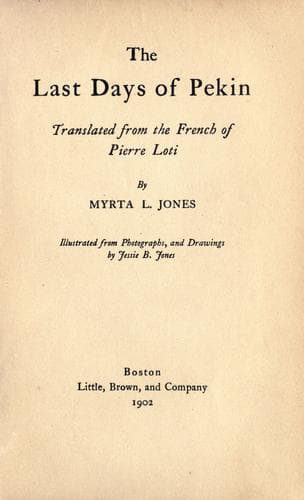
Beijing (China) -- Description and travel; Beijing (China) -- History -- Siege, 1900
The animation of these ruins, accidentally peopled by joyous soldiers,
is singular, unique, on this Sunday, which is a holiday in camp and
barracks. In the long streets filled with wreckage of all kinds,
Zouaves and African chasseurs, arm-in-arm with Germans in pointed
helmets, pass gaily between the walls of roofless houses. There are
little Japanese soldiers, shining and automatic, Russians with flat
caps, plumed Bersaglieri, Austrians, Americans with big felt hats, and
Indian cavalrymen with enormous turbans. All the flags of Europe are
floating over the ruins of Tien-Tsin, which has been partitioned by
the allied armies. In certain quarters the Chinese who have gradually
returned, after their flight, have established bazars in the open air
in the lovely sunshine of this autumn Sunday,--bazars where in the
midst of incendiary ashes they sell to the soldiers articles picked
up in the ruins, porcelains, jars, silk dresses, furs. There are so
many of these soldiers, so many uniforms of every kind on our route, so
many sentinels presenting arms, that we grow weary returning the many
salutes received as we pass through this unheard-of babel.
At the farther side of the destroyed city, near the high ramparts in
front of the palace of the viceroy, where we are going to see the
goddesses, some Chinese, undergoing torture in a kind of pillory,
are lined up along the wall, with inscriptions above them describing
their offences. Two pickets guard the doors with bayonetted guns, one
an American, the other a Japanese, standing alongside of the horrible
grinning old stone monsters who watch, crouching, on either side of the
entrance.
There is nothing sumptuous, nothing great in this dusty, decrepit
palace which we have traversed unheeding, but it speaks of real China,
of old China, grimacing and hostile. There is a profusion of monsters
in marble, in broken faience, and in worm-eaten wood, falling to pieces
from sheer old age or threatening from the edges of roofs to do so;
frightful forms half buried in sand and ashes, with horns, claws,
forked tongues, and big squinting eyes.
In the grim walled court a few late roses are still in blossom under
trees a century old.
Now, after various turns along badly lighted passages, we reach the
goddesses' door,--the one marked with two big red letters. The old
Chinese woman, ever mute and mysterious, with head held high but with
lifeless eyes persistently downcast, pushes open the black doors, with
a gesture of submission which means: "Here they are, look at them!"
Public-domain text, read in full here on John Shaqi.
Reviews
Reviews
No reviews yet
Be the first to share your thoughts on this work.
Join the Discussion
Join the discussion
Sign in to leave a comment or review.
Sign InorCreate an account