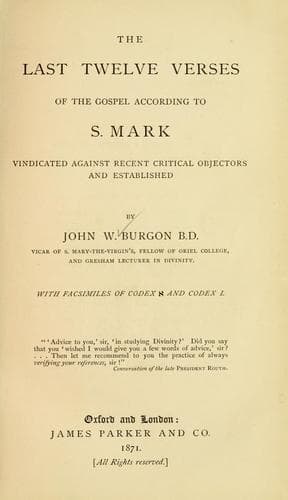
The Last Twelve Verses of the Gospel According to S. MarkBurgon, John William
Religion
The Last Twelve Verses of the Gospel According to S. Mark
Burgon, John William
Bible. Mark XVI, 9-20 -- Criticism, Textual
To this question only one answer can be returned. The exaggeration is so
gross that it refutes itself. Had it been merely asserted that the verses
in question were wanting in _many_ of the copies,—even had it been
insisted that _the best copies_ were without them,—well and good: but to
assert that, in the beginning of the fourth century, from “_almost all_”
copies of the Gospels they were away,—is palpably untrue. What had become
then of the MSS. from which the Syriac, the Latin, _all_ the ancient
Versions were made? How is the contradictory evidence of _every copy of
the Gospels in existence but two_ to be accounted for? With Irenæus and
Hippolytus, with the old Latin and the Vulgate, with the Syriac, and the
Gothic, and the Egyptian versions to refer to, we are able to assert that
the author of such a statement was guilty of monstrous exaggeration. We
are reminded of the loose and random way in which the Fathers,—(giants in
Interpretation, but very children in the Science of Textual
Criticism,)—are sometimes observed to speak about the state of the Text in
their days. We are reminded, for instance, of the confident assertion of
an ancient Critic that the true reading in S. Luke xxiv. 13 is not
“three-score” but “_an hundred_ and three-score;” for that so “the
accurate copies” used to read the place, besides Origen and Eusebius. And
yet (as I have elsewhere explained) the reading ἑκατὸν καὶ ἑξήκοντα is
altogether impossible. “Apud nos mixta sunt omnia,” is Jerome’s way of
adverting to an evil which, serious as it was, was yet not nearly so great
as he represents; viz. the unauthorized introduction into one Gospel of
what belongs of right to another. And so in a multitude of other
instances. The Fathers are, in fact, constantly observed to make critical
remarks about the ancient copies which simply _cannot_ be correct.
Public-domain text, read in full here on John Shaqi.
Reviews
Reviews
No reviews yet
Be the first to share your thoughts on this work.
Join the Discussion
Join the discussion
Sign in to leave a comment or review.
Sign InorCreate an account