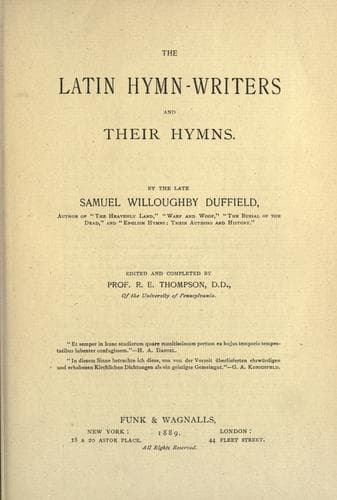
The Latin Hymn-writers and Their HymnsDuffield, Samuel Willoughby
Religion
The Latin Hymn-writers and Their Hymns
Duffield, Samuel Willoughby
Hymns, Latin -- History and criticism
When we observe the places where these fragments occur, or where singing
in the church is mentioned, we find that the language naturally is
Greek. No one doubts that Luke and the other New Testament writers
employed the tongue which was the educated and flexible medium of
conveying the loftiest truth; nor that Ephesians or Corinthians chanted
in Greek. “The Greek tongue,” say Conybeare and Howson (_St. Paul_,
1:10), “became to the Christian more than it had been to the Roman or
the Jew.” It lends itself most readily to that dithyrambic shape in
which highly emotional natures could best express their praise. So the
irregularity of the verse; its utter lack of metrical form (as Dr. Neale
found when he examined eighteen quarto volumes of it), and its
simplicity of diction, all combined to put the instrumental
accompaniment aside. Perhaps there was a prejudice—as Archbishop Trench
affirms—against a distinctively Jewish method. Perhaps there was a
disposition in this, as in other matters where art had perverted the
morals of men, to oppose whatever looked toward a possible laxity. Music
and banqueting, music and luxury, music and profligacy, went together so
much that the early Church reacted to the extreme of
Puritanism—forgetting that her Lord and Master had often worshipped in
the full-choired temple itself. In the catacombs, where every manner of
ordinary symbol may be found, there is neither pipe nor harp, nor any
sort of musical instrument—the lyre alone excepted. But neither is there
any condescension to beauty in form or color. Everything betokens a
rude, uncultivated simplicity—a piety which contented itself with the
barest and meagerest representations. It rose high enough to portray the
face of Christ, in the ancient cemetery of Domitilla, and in one carving
on a sarcophagus of the fourth century. And, remembering how repugnant
anything heathenish was to the souls of those who associated pipe and
tabret and harp with the bloody arena and the wild revelry of Rome, can
we doubt why they mingled only their unassisted voices in these chants
of praise? It can be positively added that Ambrose, Basil, and
Chrysostom do not include _instrumental_ music in their eulogies of the
Church’s practice upon this theme.
We are justified, however, in going one step beyond this bald statement,
that the early Christians _sang_ together. They sang _secum invicem_,
alternately. The quotations already given show the adaptation of their
hymns to this use. In this, at least, they were following the Jewish
habit of responses and part-singing, whatever other changes their
poverty or prejudices or principles or persecutions might have produced.
Public-domain text, read in full here on John Shaqi.
Reviews
Reviews
No reviews yet
Be the first to share your thoughts on this work.
Join the Discussion
Join the discussion
Sign in to leave a comment or review.
Sign InorCreate an account