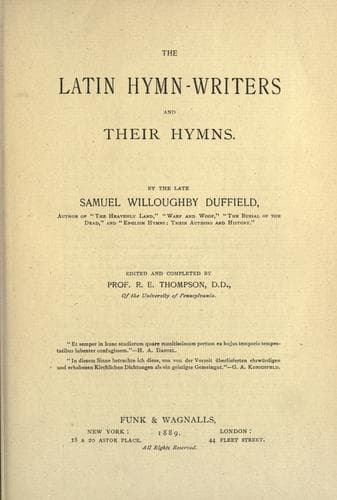
The Latin Hymn-writers and Their HymnsDuffield, Samuel Willoughby
Religion
The Latin Hymn-writers and Their Hymns
Duffield, Samuel Willoughby
Hymns, Latin -- History and criticism
It remains for us to speak of the ancient hymns which have come down to
our day. We have some information as to Harmonius and Bardesanes, who
wrote Syriac hymns in the first century, but the hymns themselves are
either lost or unidentified. Ephrem Syrus (died 378) furnishes the
earliest authentic hymns in that language. One of these (Daniel,
_Thesaurus Hymnologicus_, III. 145) is on the Nativity of our Lord, and
may be thus rendered, following Zingerle’s German version:
“Into his arms with tender love
Did Joseph take his holy son,
And worshipped him as God, and saw
The babe like any little one.
His heart rejoiced above him there,
For now the only Good had birth;
And pious fear upon him came
Before this Judge of all the earth.
Oh, what a lofty wonder!
“Who gave me then this precious Son
Of highest God, to be my child?
For I against thy mother here
Had almost been by zeal beguiled;
And I had thought to cast her off—
Alas, I saw not truly then
How in her bosom she should bear
The costliest treasure known to men,
To make my poverty, so soon,
The richest lot in mortal ken!
“David, that king of ancient days,
My ancestor, had placed the crown
On his own head, and there it lay;
But I sank deep and further down:
I was no king, but in its stead
A carpenter, and that alone.
But now may crown my brow again
That which befits a kingly throne,
For here upon my bosom lies
The Lord of lords, my very own!”
There is a trifle of doubt as to which is the very oldest Greek hymn.
One cited by Basil (died 379),
“Φῶς ἱλαρὸν ἁγίας δοξής”—κ. τ. λ.
has been by some considered the most ancient, and is known to us as,
“Hail, gladdening Light.” It is wrongly credited to Athenagenes (died
169), for Basil explicitly denies that authorship. That which it is
safest for us to receive is one found in the works of Clement of
Alexandria, and by him ascribed to an earlier author. It was probably
composed about 200 A.D.; and while it is too long to quote, it may be
characterized as dithyrambic, and almost Anacreontic, in rhythm. It
begins:
“Στροµίον πώλων ἀδαῶν.”—κ. τ. λ.
and is known as “Shepherd of Tender Youth,” from its best English
version, by the Rev. Dr. H. M. Dexter, of Boston. The Φῶς ἱλαρὸν is also
accessible in Longfellow’s beautiful translation in the Golden Legend,
commencing, “O gladsome light.”
As we turn the pages on which Daniel and Mone have recorded these hymns
of the earliest age of the Church, we observe that they are either in
praise of Christ or of God, or are songs of worship for the morning or
the evening. Their simplicity is admirable. Here is one called ἦχος—an
“Echo”—literally rendered:
“We who have risen from our sleep
Worship before thee, O Good One.
And, of the angels the hymn
We cry aloud to thee, thou Mighty One;
Holy, holy art thou, O God,
And of thy mercy have pity on us!
Public-domain text, read in full here on John Shaqi.
Reviews
Reviews
No reviews yet
Be the first to share your thoughts on this work.
Join the Discussion
Join the discussion
Sign in to leave a comment or review.
Sign InorCreate an account