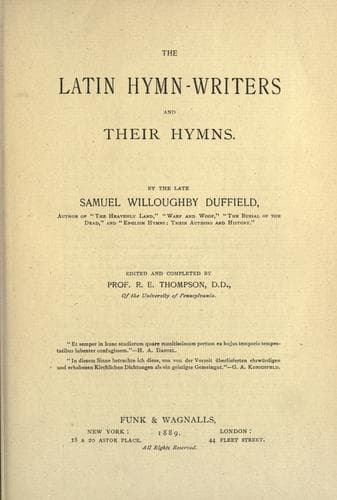
The Latin Hymn-writers and Their HymnsDuffield, Samuel Willoughby
Religion
The Latin Hymn-writers and Their Hymns
Duffield, Samuel Willoughby
Hymns, Latin -- History and criticism
“From my couch and from my sleep
Thou hast raised me, O Lord;
Enlighten my mind and my heart,
And open thou my lips
To praise thee, Holy Trinity,
Holy, holy, holy art thou!
“Suddenly shall come the Judge,
And the deeds of each shall be laid bare;
But guard us from fear in the midst of the night,
Holy, holy, holy art thou!”
Another of these unplaced, anonymous, and possibly very ancient hymns,
may be given in full for comparison:
“Ψυχή µου, ψυχή µου,
Ἀνάστα, τί καθεύδεις;
Τὸ τέλος ἐγγίζει,
Καὶ µήλλεις θορυβεῖσθαι;
“Ἀνάνηψον ὀυν, ἵνα
Φείσηται σου Χριστὸς
Ὁ Θεὸς, ὁ πανταχοῦ παρὼν
Καὶ τὰ πάντα πληρῶν.”
“O soul of mine, O soul of mine,
Arise, why sleepest thou?
The end of earth is drawing near
And art thou fearful now?
Be sober therefore, O my soul,
That He who filleth space
And filleth time, our Saviour, God,
May spare thee by His grace.”
And this beautiful little doxology:
“My hope is God,
My refuge is the Lord,
My shelter is the Holy Ghost;
Be thou, O Holy Three, adored!”
In such sweet and simple language did the early Christians sing their
“praise to Christ, as God.” They understood the true meaning of a hymn
as Ambrose and St. Bernard also understood it—and as Gregory Nazianzen
and Adam of St. Victor never knew it at all. In 1866 Professor Coppée
could truly declare that there was no collection of sacred verse in
which this thought of adoration and of worship was “the leading
feature.” It is better now; but even to-day there is an honored place
for any book of praise in which the formal and didactic shall be done
away, and where nothing shall be found but the pure reverence of a
loving and trusting soul.
Of old, in the temple, there was kept—said the rabbins—a flute of reed,
plain and straight and simple, but of marvellous sweetness. It came down
from Moses’ day. But the king commanded his goldsmiths to cover and
adorn it with gold and gems. And, lo, the sweetness of the reed flute
was forever gone! Thus, perchance, in our later art and our foolish
wisdom, it may be we have often spoiled the ancient hymns!
CHAPTER II.
THE STUDY OF THE LATIN HYMNS.
The genealogy of the song of praise in the mediaeval and modern
Christian Church is both simple and beautiful. It begins far back, as we
have seen, in the chants and psalms of the Hebrew. Then it changes to
the Syriac and the Greek. Then it emerges into the Latin. Next it is
caught up in the old High-German poetry, and at length it becomes the
modern English hymn. The line of direct descent is like that of some
high and puissant family whose inheritance is transferred now to one
branch and now to another, but whose noble lineage is never lost.
Public-domain text, read in full here on John Shaqi.
Reviews
Reviews
No reviews yet
Be the first to share your thoughts on this work.
Join the Discussion
Join the discussion
Sign in to leave a comment or review.
Sign InorCreate an account