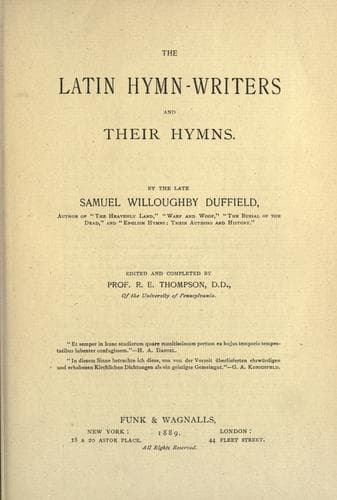
The Latin Hymn-writers and Their HymnsDuffield, Samuel Willoughby
Religion
The Latin Hymn-writers and Their Hymns
Duffield, Samuel Willoughby
Hymns, Latin -- History and criticism
When the reader or the worshipper is attracted to-day by some ancient
hymn-writer’s name, he naturally asks for information. He is aware that
hymnology is called a branch of study, like any other scholastic
pursuit. He is also aware that the more usual English and German hymns
have their historians, and, to a limited degree, that they have been
analyzed, classified, compared, and their text settled. Even their
impelling causes and surroundings are known, as in the case of the
touching lyrics of George Neumark and Paul Gerhardt, or the pathetic
strains of Cowper, or the stirring notes of Charles Wesley.
But occasionally a bird of strange plumage flies across this peaceful
sky or perches and sings in these religious groves. The name of some
Greek father—an Anatolius or a John of Damascus—appears as the original
author. The hymn-horizon widens out to an earlier age. When one sings
the _Te Deum Laudamus_, he discovers that it has its antecedent in the
Greek liturgy. And when he employs that fine version of Bishop Patrick,
“O God, we praise Thee and confess,”
he is put upon a track of inquiry by which he discerns an even earlier
rendering in the oldest prayer-books, beginning—
“We praise Thee, God, we knowledge Thee
The only Lord to be.”
These little hints and stray gleams of outlook through the mists of
uninformation are intensely alluring. And when by some happy chance it
is learned that this old Latin sequence is traditionally ascribed to
Ambrose, Bishop of Milan; when it is accredited to the spontaneous
utterance of Augustine and his great preceptor at the time of
Augustine’s baptism; when it is noted as a derivative from that Greek
psalmody whence the holy Ambrose obtained so many of his hymns; and when
it opens thus a door into the heaven of the earlier worship of the
Church, then indeed the reader is proportionately stimulated to further
question.
For the most part it will be found that the Latin language contains the
best of the Greek, and the inspiration of the majority of the first
German hymns. In the dead ark of the Middle Ages was kept this rod that
budded and this golden pot with its sacred heavenly food. It is amazing
that this treasure has been so well preserved, but it is none the less
certain that we now have it safely, never to be lost again.
Public-domain text, read in full here on John Shaqi.
Reviews
Reviews
No reviews yet
Be the first to share your thoughts on this work.
Join the Discussion
Join the discussion
Sign in to leave a comment or review.
Sign InorCreate an account