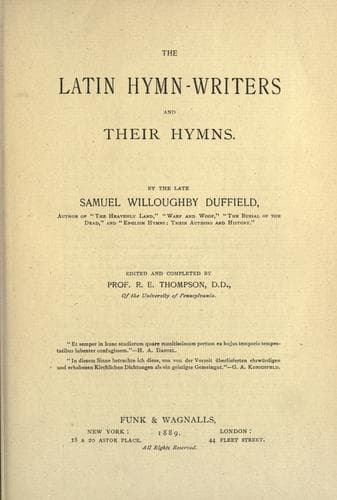
The Latin Hymn-writers and Their HymnsDuffield, Samuel Willoughby
Religion
The Latin Hymn-writers and Their Hymns
Duffield, Samuel Willoughby
Hymns, Latin -- History and criticism
There are no Latin hymns—let us here say—earlier than Hilary of Poitiers
(died 366). His _Hymnarium_ has perished, and all but one of the
compositions attributed to himself are doubtful. The “evening-song”
which he sent to his daughter Abra, while he was in exile among the
followers of the Eastern Church, forms the connecting link between Greek
and Latin hymnody. The true _hymn_—a different thing from the rhythmic
but unmetrical _sequence_—here takes its rise. In this small, pure
fountain-head reappear the percolating praises of the two previous
centuries. The short lines drop with a gentle tinkling melody upon the
ear. As yet there is no rhyme, although there is an occasional
lightening of the lyric by some such verbal art.
But with Ambrose the full stream begins to sweep along. There can be no
doubt that many ungathered and traditional stanzas were in his time
discoverable in the Church—much as it can be observed that phrases in
prayer or in exhortation are the inheritance of our own generation from
days of struggle and of trial among our Christian ancestors. And what
better could a beleaguered bishop do, when he was shut up in a church
“for the word of God and the testimony of Jesus Christ,” than to collate
these old hymns? Twelve possibly—eight, or less, with moderate
certainty—can be regarded as of his own composition. The rest of the
ninety or a hundred are commonly received as “Ambrosian,” since they
share his spirit and partake in some degree of his method. The rules of
the Venerable Bede are not infallible, and modern criticism frequently
rejects what the early collectors are disposed to assign to this single
illustrious source.
Augustine wrote no actual hymns, but he was the cause of hymns in
others—as, notably, in the case of Cardinal Peter Damiani. The Ambrosian
music and the Augustinian theology served for inspiration to many later
men. Yet the assignment of these Latin hymns to their proper authors is,
at the best, a most precarious undertaking. A few, quoted or mentioned
by competent witnesses—as when Augustine quotes Ambrose—seem duly
authentic. This is, however, a rare occurrence. Generally we proceed
upon the mere _dictum_ of the first compilers—especially of Thomasius,
George Fabricius, and Clichtove.
These early compilations are sufficiently scarce. Professor Dr. H. Ad.
Daniel gives a list of some which, except for the books of “the
venerable Thilo” in the Yale Library, are beyond the reach of American
students. Dating from 1492 and running into the first decade of the
sixteenth century there were many “Expositions” of hymns, of which the
work of Clichtove (Basle, 1517) remains to us in the greatest number of
editions. Up to the middle of the present century this book was
practically indispensable to any correct knowledge of the original
texts. Since that time it, as well as every similar work, has received
attention, and its contents have been often reproduced.
Public-domain text, read in full here on John Shaqi.
Reviews
Reviews
No reviews yet
Be the first to share your thoughts on this work.
Join the Discussion
Join the discussion
Sign in to leave a comment or review.
Sign InorCreate an account