The Latin Hymn-writers and Their Hymns — John Shaqi
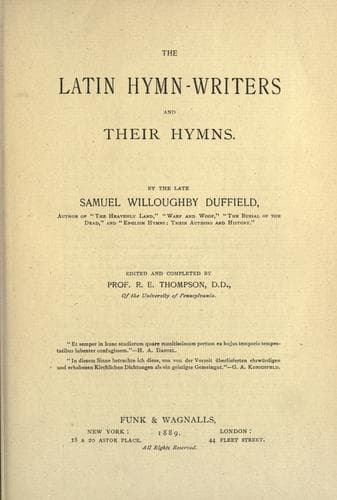
The Latin Hymn-writers and Their HymnsDuffield, Samuel Willoughby
Religion
The Latin Hymn-writers and Their Hymns
Duffield, Samuel Willoughby
Hymns, Latin -- History and criticism
And as to his emergence from heathenism, there can be nothing more
satisfactory to us than his own story. He has recorded that when he
found, in Exodus, how God was called “I am that I am,” and when he read
in Isaiah (40:12) of a deity who “held the wind in His fists,” and again
(66:1) of Him who said, “Heaven is My throne and earth is My footstool,”
then this _Deus immensus_ surpassed all his heathen conceptions of
grandeur and power. And when he read (in Ps. 138:7) how this great God
loved and cared for His children, so that one could say, “Though I walk
in the midst of trouble, Thou wilt revive me; Thou shalt stretch forth
Thine hand against the wrath of mine enemies, and Thy right hand shall
save me”—then he was drawn toward this mighty being by a sentiment of
confidence and trust. He also—turning the pages of the Wisdom of Solomon
(13:5) in the Apocrypha—found it written that “by the greatness and
beauty of the creatures proportionately the Maker of them is seen.” And
then, encountering the Gospel of John, its opening sentences clarified
his mind. All became plain. He accepted with calmness, firmness, and
dignity the great doctrines of the Christian faith. He was imbued with
John’s conception of that Word, “which was in the beginning” and “which
was God.” From that moment he had a theology which was as pure as
crystal and as indestructible as adamant. There is no muddiness about
his ideas from this time onward, though Arians buzz and sting, and
calamities rain upon him, and the path of duty is deep with mire and the
future is dark. Every one of these things passes away. His own language
as to this great change in his belief is as characteristic as it is
beautiful: “I extended my desires further, and longed that the good
thoughts I had about God, and the good life which I built on them, might
have an eternal reward.” Like one of his own favorite saints in the
Gospel and the Apocalypse of John, he was thus “led by the Spirit of
God” to become one of the chanting choir before the throne.
It matters very little, therefore, to us of to-day, that, in 1851, Pius
IX., himself a man of sweet and gentle temper, made Hilary a “Doctor of
the Church”—a distinction reserved for those greatest ones, like
Augustine and Chrysostom, whose learning and eloquence are
world-renowned. The dead bishop did not need this posthumous
distinction. He has long been recognized—to quote Professor Dorner—as
“one of the most original and profound,” albeit not the easiest to
understand at all times, of the great teachers of the Christian Church.
We may hereafter attach more value to his work even than we do at
present.
Public-domain text, read in full here on John Shaqi.
Reviews
Reviews
No reviews yet
Be the first to share your thoughts on this work.
Join the Discussion
Join the discussion
Sign in to leave a comment or review.
Sign InorCreate an account