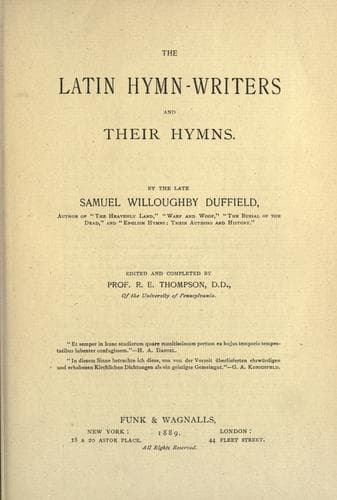
The Latin Hymn-writers and Their HymnsDuffield, Samuel Willoughby
Religion
The Latin Hymn-writers and Their Hymns
Duffield, Samuel Willoughby
Hymns, Latin -- History and criticism
This then was the man who had determined to enter upon a Christian life.
He was already married and had one daughter—Abra by name—and possessed a
certain repute as a man of reading and of affairs. His origin protected
him from a contempt of pagan learning; and his marriage protected him
from that one-sided development which has Romanized the once Catholic
Church. The period in which he lived was one of transition—from classic
literature to Christian literature, and from the Latin of far-off Virgil
and Cicero to the Latin which was to become the uniting tongue of all
scholars in that Babel of the Middle Ages. This language was now shaping
itself to its new work and becoming, like English under the genius of
Chaucer, a living speech. In the moulding hands of these first Christian
writers it became flexible, not always fluent or graceful or even
strictly grammatical, but capable at least to carry what would otherwise
have been lost. Greek was gone, and French and German and English had
not yet appeared. As a Gallo-Roman, then—a post-classic Latinist—Hilary
gives in his allegiance to Christianity, and his wife and daughter are
baptized with him into the true faith.
So far much is conjectural; and more is vague and to be derived from the
shadows cast upon the screen of history by the “spirit of the years to
come yearning to mix itself with life.” We emerge, however, into
historical certainty about the year 351. Then, on the death of their
bishop—who is thought to have been Maxentius, the brother of St. Maximin
of Trier—his townspeople clamored for Hilary. The _Histoire Litteraire
de la France_ sets this election down for the year 350; but that
authority, in this and a great many other instances, is profuse and
multitudinous and not absolutely safe. We are certainly not far out from
the correct date in saying 351.
It illustrates a condition of things which are suggestive of the
simplicity of the early Church, when we find that in spite of his being
a married man and a father—and in spite of Cyprian’s and of Tertullian’s
praises of celibacy—Hilary was heartily chosen and almost forced into
the episcopate. In this position he exhibited “all the excellent
qualities of the great bishops.” We are told that he was “gentle and
peaceable, given particularly to an ability to persuade and to
influence.” With these he joined “a holy vigor which held him firm
against rising heresies.” And Cassian says that Hilary “had all the
virtues of an incomparable man.” The fact, after all, speaks for itself
more loudly than these commendations. He was so much one of themselves
that the people of Poitiers would not have selected him, if they had not
known him to be the best man for the mitre.
Public-domain text, read in full here on John Shaqi.
Reviews
Reviews
No reviews yet
Be the first to share your thoughts on this work.
Join the Discussion
Join the discussion
Sign in to leave a comment or review.
Sign InorCreate an account