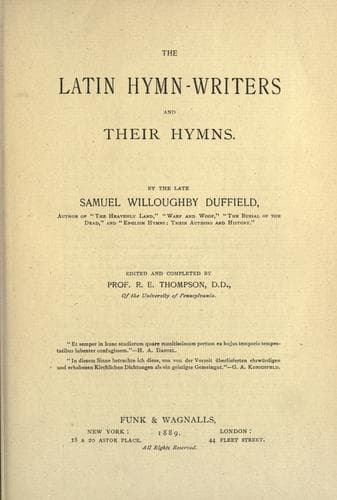
The Latin Hymn-writers and Their Hymns — John Shaqi
The Latin Hymn-writers and Their HymnsDuffield, Samuel Willoughby
Religion
The Latin Hymn-writers and Their Hymns
Duffield, Samuel Willoughby
Hymns, Latin -- History and criticism
From this time began that career of stainless honor which has outlasted
the very walls which echoed his voice. He was known from Great Britain
to the Indies. He ranks second only to Athanasius as a defender of the
faith; and—as we already noted—he is classed by Jerome with the great
bishop of Hippo whose portrait is given to us so vividly in Charles
Kingsley’s _Hypatia_. And to us of our century and of our convictions in
favor of charity and culture, it is particularly praiseworthy that he
never gave up his secular scholarship, and that he never flagged or
faltered in defending opinions which were as large and liberal as they
were undeniably orthodox. He was an oak which stood against the blast
unshaken, and which yet held, in the heart of its great branches, sweet
nests of singing birds and leafy coverts of shade and peace.
Hilary was not suffered to be inactive. It was the period at which the
Arian heresy was in full incandescence. No one holding the opinions of
the Bishop of Poitiers could well remain neutral. He had—in conformity
with a custom soon to become a law—separated his life from that of his
home; but he appears always to have cherished a warm love for his wife
and child. This placed him, however, in perfect freedom from other
cares, and at liberty to devote himself to the eradication of false
doctrine. Constantius, the Emperor, was an Arian, and this made the
perplexity of the position very great. An honest man might ruin all by
his blunt independence—but an honest man dare not be silent. And,
besides, Hilary had neither attended the Synod of Arles (353) nor that
of Milan (355), and was somewhat out of the ecclesiastical tide.
That he was no coward was soon shown to everybody’s satisfaction. He
prepared a letter to the Emperor as brave as it was keen, and which
touched up with a vigorous lash the cringing sycophants and shuffling
hypocrites about the court. Hilary is notably strong when he denounces
the substitution of force for reason—and perhaps his doctorate came to
him only in 1851 (when he could not well care much for it) because this
doctrine of his was not altogether what Mother Church has been in the
habit of teaching and practising! I may refer to the recent work of the
Rev. R. T. Smith upon _The Church in Roman Gaul_ as fully confirming
this statement. St. Martin of Tours is there called to bear testimony
that the Bishop of Poitiers held such opinions just as sturdily in his
days of power as in these times of trial and persecution. He was, in
short, a thoroughly sincere man, and it took him only a few years—until
355—to get into the hottest bubbling spot of all the caldron. At that
date, in company with other leaders of the church in Gaul, he drove out
a very pestilent fellow—Saturninus, the Bishop of Arles—as a seditious
and irreconcilable element in their midst. With him was cast out Valens,
and with Valens was cast out Ursacius. But of all these, Bishop
Saturninus was the angriest and the most revengeful.
Public-domain text, read in full here on John Shaqi.
Reviews
Reviews
No reviews yet
Be the first to share your thoughts on this work.
Join the Discussion
Join the discussion
Sign in to leave a comment or review.
Sign InorCreate an account