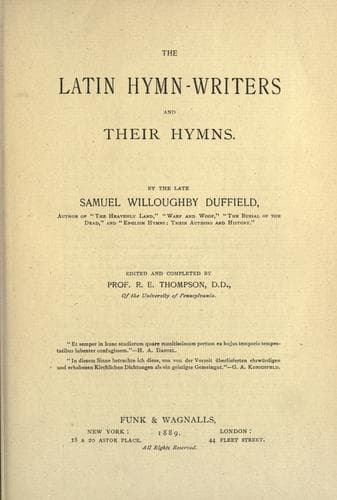
The Latin Hymn-writers and Their Hymns — John Shaqi
The Latin Hymn-writers and Their HymnsDuffield, Samuel Willoughby
Religion
The Latin Hymn-writers and Their Hymns
Duffield, Samuel Willoughby
Hymns, Latin -- History and criticism
A year of something like good order followed, when lo, the Arians came
to the front with a synod of their own complexion at Beziers. Here
Hilary found himself in the vocative case altogether. The tables were
turned upon him, and it was he who must now go forth a banished man. The
power was against him, and he set out with bowed head and sad heart upon
one of those pride-humbling journeys which have not seldom brought the
greatest results to religion, and which not a few of the best men have
taken in their day. In this manner Bernard went to meet Abaelard; Martin
Luther went to the diet at Worms; and John Bunyan took his way to
Bedford jail.
Principal among the causes of his sadness was that he was snatched away
from his constant and congenial duty of explaining the Scriptures to the
people of his diocese. Still he had nothing for it but to go; and so,
somewhere about 356, we find him in Phrygia. He is accompanied by
Rodanius, Bishop of Toulouse, who had plucked up considerable courage by
seeing how well Hilary took his defeat.
In 357 the Church in Roman Gaul sent him their greeting, from which that
of his own Poitiers people was not absent. And the Gallic bishops,
having perceived him to be capable of much good service in his enforced
residence abroad, bade him inform himself and them upon the creeds and
customs of the Eastern Church. This he had already, to a degree,
undertaken. And in 359, whom do we find entering a convocation of
bishops at Seleucia but our very Hilary, opposing with a strong and
unflinching philosophic power all those—and there were many there—who
denied the consubstantiality of the Word.
There were one hundred and sixty of these bishops at Seleucia, of whom
one hundred and five—a very handsome majority—were “semi-Arians.” Of the
remaining fifty-five there were nineteen classed as Anomoeans—those who
held that the Son was _unlike_ the Father in essence, or ἀνόµοιος—and
the rest were heretics of different grades of badness. It was the
natural outcome of the difficulties with Athanasius, where the royal
authority was on the side of the Arians. The Roman Catholic historians
are therefore not complimentary to this synod—or rather “double council”
of Seleucia and Rimini—and this was assuredly no very comfortable body
of Christians for a banished bishop to exhort. But he did it with
effect, and proceeded to the council at Constantinople (360) and did it
again; and presently (361) Constantius died and the Nicene Creed was
victorious.
Public-domain text, read in full here on John Shaqi.
Reviews
Reviews
No reviews yet
Be the first to share your thoughts on this work.
Join the Discussion
Join the discussion
Sign in to leave a comment or review.
Sign InorCreate an account