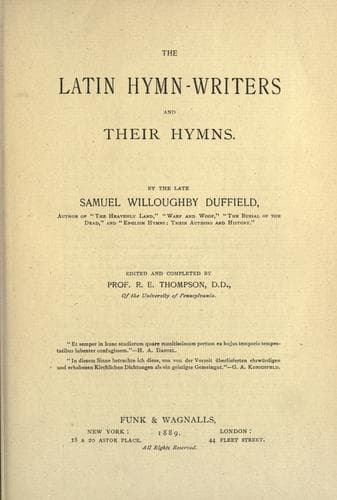
The Latin Hymn-writers and Their HymnsDuffield, Samuel Willoughby
Religion
The Latin Hymn-writers and Their Hymns
Duffield, Samuel Willoughby
Hymns, Latin -- History and criticism
So was Hilary, who—in 360-61—returned to Poitiers, where, as soon as his
crozier was once more well in hand, he levelled Saturninus and compelled
him to abandon his diocese. He then turned upon Auxentius of Milan, who
only escaped the same or a worse fate by clinging to Valentinian, the
reigning Emperor, and was denounced by Hilary as a hypocrite for his
pains. Our bishop appears in these days to have been decidedly a member
of the Church Militant; and perhaps it was natural enough when one had
survived the reigns of Constantius, Julian the Apostate, and Jovian, for
him to be as he was. I am not commenting upon these exciting scenes; I
desire rather to go back and show how they produced the hymns of which
we are to speak.
It was in 357—at the same date with the letters from the bishops and
from the churches—that Abra, his daughter, wrote to him herself. From
this epistle we learn that her mother still lived, and we observe the
dutiful and loving daughter apparent in every line. In reply Hilary
sends a well-composed and even imaginative letter. Under the figures of
a pearl and a garment he charges her to keep her soul and her conduct
pure. He rather recommends a single life, but not in any such
extravagant eulogy of celibacy as some would have us suppose. It is more
after the style of what Grynaeus affirmed of him—that he was so moderate
in these opinions as to suffer his canons to marry—since it would be
hard for an unbiassed mind to draw any harsh conclusions from the
language; yet all this is of small consequence compared with the
enclosure—two Latin hymns, one for the morning and one for the evening,
which she may use in the worship of God. The first of these is the
_Lucis largitor splendide_; but the second is probably lost. It is said
that it was the hymn, _Ad coeli clara non sum dignus sidera_—“To the
clear stars of heaven I am not worthy,” etc. This is very doubtful
indeed, so much so that we may decline to receive it on several grounds.
It is to be found in the superb folio edition of Hilary’s works (Paris,
1693) prepared by the Benedictines of St. Maur. Yet if internal evidence
is to weigh at all we must reject it without scruple. It is not a hymn
in any true sense, and certainly has no reference to the _evening_ hour
of worship. It contains a gross phrase or two, which are not suggestive
of Hilary, who would scarcely have said that he would “despise Arius” by
“modulating a hymn” against him, nor would he have spoken of the
“barking Sabellius” or the “grunting Simon.” The verses are unpleasantly
flavored with earthliness, and to think that a young girl would be
inclined to sing ninety-six lines of an abecedary—or “alphabet-hymn”—is
absurd. Moreover, the editors of the edition of 1693 only print four
stanzas, and express their own disbelief that Hilary wrote it, based
upon these facts and upon their no less important criticism of the
style, which is _masculine_ throughout, and refers to ideas highly
inappropriate to the use intended.
Public-domain text, read in full here on John Shaqi.
Reviews
Reviews
No reviews yet
Be the first to share your thoughts on this work.
Join the Discussion
Join the discussion
Sign in to leave a comment or review.
Sign InorCreate an account