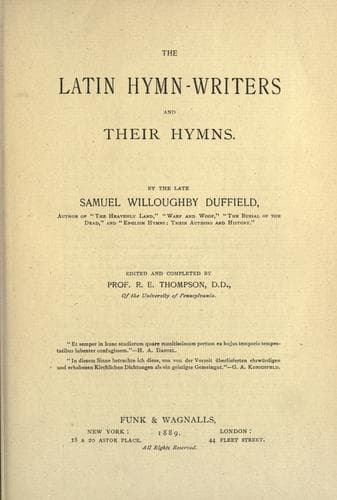
The Latin Hymn-writers and Their HymnsDuffield, Samuel Willoughby
Religion
The Latin Hymn-writers and Their Hymns
Duffield, Samuel Willoughby
Hymns, Latin -- History and criticism
Mone is nearer to the correct
doctrine when he assigns it to a period between the sixth and eighth
centuries. Daniel (4:130) prints it in full and quotes Mone’s remark
that an Irish monk is likely to have been its author. It is in the metre
familiar to modern eyes in the _Integer vitae_ of Horace, but it
displays neither taste nor poetry nor any religious fervor. That it
begins each stanza with a consecutive letter of the alphabet is no proof
of anything except wasted ingenuity. So that, I repeat, we do well to
reject it and to leave it rejected.
All, then, that is left us is the _Lucis largitor splendide_—“Thou
splendid giver of the light.” The letter went back from Seleucia to
Poitiers and carried this hymn, at least, with it. Hilary had sent this
and its companion, _ut memor mei semper sis_—“that you may always
remember me.” And we may fancy the lovely high-born daughter of that
earnest and scholarly man as, daily and nightly, she sits at her
window—perchance with her gaze wistfully turned to the eastward. There
she sang these simple, beautiful hymns—she the first singer of the new
hymns of the Latin Church. Among the themes for Christian art yet left
to us there is hardly one more suggestive than this—for Abra doubtless
sang her father’s hymns to her father’s loyal people. It may even be
supposed that he gave her the tunes as well as the words, and that, by
morning and by night, the battle-scarred Poitiers re-echoed this voice
of the exiled bishop.
Of the hymn itself as much can be said in favor as we have just said
against its pretended and ill-matched companion. It breathes the
Johannean sentiments throughout. It celebrates the Light, the Son of
God, the glory of the Father, “clearer than the full sun, the perfect
light and day itself.” To one who is acquainted with the Greek hymns it
is instantly suggestive of those pellucid songs—its atmosphere is all
peace and its trust is as restful to the tired spirit as the quiet
coming of the rising day. It may easily have been a translation from the
Greek, or, even more easily, the natural up-gush of melody which was
touched into life by the frequent hearing of the Eastern hymns. Hilary
never learned it in an Arian church, nor did he find it among
controversialists. Its nest, where it was first reared, was in some
corner of a catacomb or in some nook of the Holy Land. This hymn, then,
we may safely accept as the oldest authentic original Latin “song of
praise to Christ as God.”
Public-domain text, read in full here on John Shaqi.
Reviews
Reviews
No reviews yet
Be the first to share your thoughts on this work.
Join the Discussion
Join the discussion
Sign in to leave a comment or review.
Sign InorCreate an account