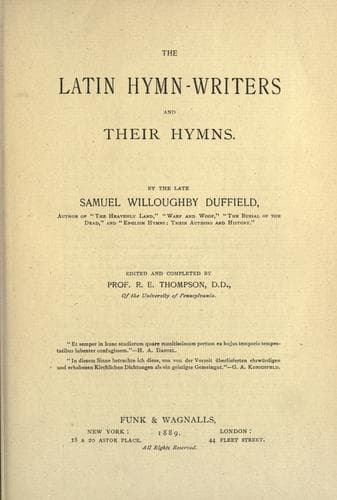
The Latin Hymn-writers and Their HymnsDuffield, Samuel Willoughby
Religion
The Latin Hymn-writers and Their Hymns
Duffield, Samuel Willoughby
Hymns, Latin -- History and criticism
It was undoubtedly believed at the time of the fourth Council of Toledo
that he had written many pieces “in favor of God, and of the triumphs of
apostles and martyrs;” and both Jerome and Isidore of Seville declare
him to have been the first among the Latins to write Christian verse.
But to show how uncertain is the conjecture that is thus started, I may
mention that the _Ut queant laxis_ of Paul Winfrid, the “Deacon,” is
credited to Hilary by the _Histoire Litteraire_. The same authority also
claims for him the first _Pange lingua_ (_Pange lingua gloriosi,
praelium certaminis_), which is sometimes assigned to Claudianus
Mamertus, but is the well-authenticated composition of Venantius
Fortunatus, the troubadour and friend of Radegunda, the wife of
Clotaire. We may as well admit that a great man did not necessarily do
all the great things of his day.
Besides, the search after truth in this matter is complicated
marvellously by the trade of the hymn-tinkers, who put new bottoms and
tops and sides to a great many religious lyrics. Here is a case in point
in Mone (vol. iii., p. 633). The hymn begins _Christum rogemus et
patrem_—“We call on Christ and on the Father.” It has seven stanzas. The
_first_ stanza is from a morning hymn, supposed to be by Hilary. The
_second_ is from an Ambrosian hymn. The _third_ and _fourth_ are from
another Ambrosian hymn to the Archangel Michael. The _fifth_ is from a
very noble Ambrosian hymn—the _Aeterna Christi munera_—of which Daniel
says that it itself has been “wretchedly torn to pieces by the Church”
(_ab ecclesia miser e dilaceratum_). The _sixth_ and _seventh_ stanzas
are also Ambrosian—from the _Jesu corona virginum_. Thus this single
hymn of seven stanzas is mere patchwork, gathered from that Ambrosian
hymnody which the Breviaries supply. And finding all the rest of it
credited to Ambrose and to his century, we are inclined to doubt that
Hilary should be considered as the author of any portion at all.
Public-domain text, read in full here on John Shaqi.
Reviews
Reviews
No reviews yet
Be the first to share your thoughts on this work.
Join the Discussion
Join the discussion
Sign in to leave a comment or review.
Sign InorCreate an account