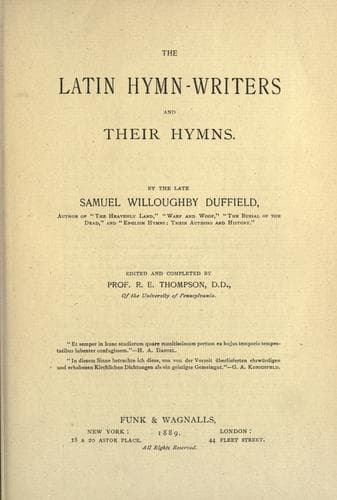
The Latin Hymn-writers and Their HymnsDuffield, Samuel Willoughby
Religion
The Latin Hymn-writers and Their Hymns
Duffield, Samuel Willoughby
Hymns, Latin -- History and criticism
Indeed the identification of Hilary’s hymns—except the _Lucis
largitor_—is purely conjectural. It rests mainly on the hymnological
acumen of Cardinal Thomasius, which may or may not be liable to error.
Kayser refuses, on one ground or another, to positively endorse any,
except the one which all now concede. Next to this in probability stands
the _Beata nobis gaudia_ (though it is doubted by Professor March), and
then the _Deus pater ingenite_, which is taken from the Mozarabic
Breviary. The _Jam meta noctis transiit_, the _In matutinis surgimus_,
and the _Jesu refulsit omnium_, have only the authority of Thomasius.
The _Jesu quadragenariae_, Daniel says, is an old hymn, but very
certainly composed later than the time of Hilary. The _Ad coeli clara_
we have already rejected. Thus we have one authentic and five
conjectural Hilarian hymns. There is, however, great doubt resting on
the _Jesu refulsit omnium_; and if I consulted merely my own judgment, I
should declare against it, if only in view of the _rhymes_—a
characteristic which it would scarcely possess if it were genuinely of
the fourth century. And while we are upon this somewhat ungrateful duty
of trying to set matters right, shall we pass over the slip which Mrs.
Charles makes in her capital little book? (_Christian Life in Song._ Am.
ed., p. 74.) For she says that “The Hilary who wrote the hymns was the
canonized Bishop of Arles.” There was, much later, a Hilary of Arles;
and there was another Hilary of Rome, and there were also others of the
same name; but none of them wrote hymns. He of Arles assuredly did not.
Of our own Hilary it may be added that the rest of his life was earnest,
but comparatively quiet. We shall find Gregory of Tours and Fortunatus
asserting that he raised the dead and healed the sick, and cast out
devils (some of them in the shape of snakes) from a boy’s stomach; but
these stories belong naturally to a credulous and superstitious age.
More to the purpose is it to find that the bishop had entered upon the
composition of tunes for his hymns, and had taken up calligraphy and the
ornamentation of manuscripts. There was a book of the Gospels found, on
which was indorsed, “_Quem scripsit Hilarius Pictavensis quondam
sacerdos_”—“which Hilary of Poitiers, formerly a priest, wrote.” A
similar book was left by St. Perpetuus, Bishop of Tours, to Bishop
Euphronius, Fortunatus’s friend. This is attested by his will, executed
in 474. “I saw,” says Christian Druthmar (ninth century), “a book of the
Gospels, written in Greek, which was said to have been St. Hilary’s, in
which were Matthew and John,” etc. But whether Hilary wrote this is
naturally an open question.
Public-domain text, read in full here on John Shaqi.
Reviews
Reviews
No reviews yet
Be the first to share your thoughts on this work.
Join the Discussion
Join the discussion
Sign in to leave a comment or review.
Sign InorCreate an account