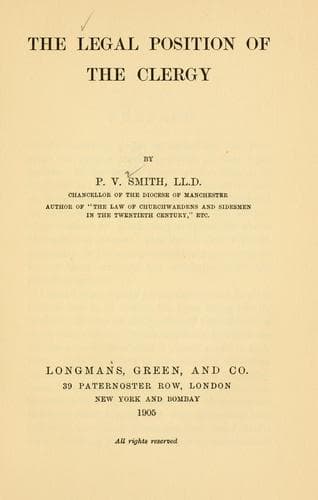
The Legal Position of the ClergySmith, Philip Vernon
Religion
The Legal Position of the Clergy
Smith, Philip Vernon
Canon law; Clergy -- Legal status, laws, etc. -- Great Britain; Ecclesiastical law -- Great Britain
Many portions of them are, however,
now obsolete; and Canon 36 and the last words of Canon 102 have been
superseded by new canons made in 1865-66 and 1888. The Canons of 1640
were passed after the dissolution of Parliament, which, according to the
custom of the realm, put an end also to the existence of Convocation,
and they have no legal force.[4]
4. Much discussion has arisen upon a fourth source of Church law,
namely, the decisions of our ecclesiastical courts. It is important to
draw a clear distinction between legislative and judicial functions. A
court, whether ecclesiastical or civil, has nothing to do with enacting
laws. Its province is confined to interpreting them, when their meaning
is obscure or disputed. No doubt, in the course of this interpretation,
it will sometimes make law by deciding in a particular way a point on
which the legislature has left the matter in doubt, and has not itself
clearly laid down the law. Many questions affecting the clergy and the
Church have, in fact, been thus determined by our civil as well as by
our ecclesiastical tribunals. But if one of our civil courts, in
interpreting the civil law, delivers a decision which does not commend
itself to the common sense of the nation, it is recognised that the
remedy lies not in altering the constitution of the court and
endeavouring to obtain a fresh legal decision which shall upset the
other, but in obtaining an Act of Parliament expressly overruling the
unsatisfactory decision. If this is not done, the law may have been
technically judge-made, but it is acquiesced in and assented to by
Parliament and the nation. The same principle applies to the decisions
of ecclesiastical courts. The natural way of getting rid of an obnoxious
decision is not by fresh adjudication, but by legislation. Until it has
been reversed by one or other of these means, the decision of a court,
which _de facto_ possesses ecclesiastical jurisdiction, is binding upon
the Church as part of her law for the time being. We have somewhat lost
sight of this principle, owing to the extreme difficulty of obtaining
any definition or alteration of Church law by a legislative process.
But the true remedy lies in a healthy revival of the exercise of
ecclesiastical legislation, and not in an endeavour to make the
ecclesiastical judicature, whether as now existing or after a reform of
the courts, discharge legislative functions which are wholly outside its
proper province.
Public-domain text, read in full here on John Shaqi.
Reviews
Reviews
No reviews yet
Be the first to share your thoughts on this work.
Join the Discussion
Join the discussion
Sign in to leave a comment or review.
Sign InorCreate an account