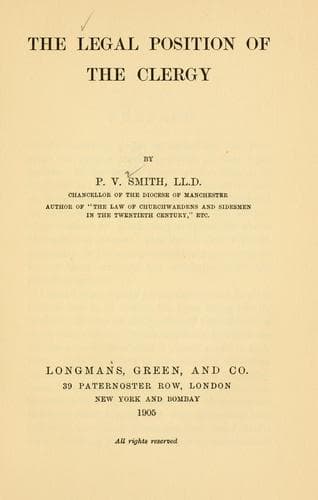
The Legal Position of the ClergySmith, Philip Vernon
Religion
The Legal Position of the Clergy
Smith, Philip Vernon
Canon law; Clergy -- Legal status, laws, etc. -- Great Britain; Ecclesiastical law -- Great Britain
partner, or shareholder in any benefit society, or fire or life
assurance society, and may sell minerals from mines on his own lands,
and also (provided he do not do so in person at a market or other public
sale) may buy and resell for profit cattle, corn, and other things
required for the occupation, cultivation, and improvement of glebe or
other lands lawfully held by him. The penalties for unlawfully trading
are, for the first offence, suspension for not exceeding one year, for
the second offence suspension for a longer period, and for the third
offence deprivation _ab officio et beneficio_.[27]
17. Both clergymen and other ministers of religion are specially
protected in the performance of religious rites, including rites of
burial, in a church or other place of worship, or a churchyard or
burial-place. It is a misdemeanour punishable by imprisonment with or
without hard labour, to offer violence to them or arrest them upon any
civil process while engaged in or going to or returning from the
performance of these rites, or to obstruct or endeavour to obstruct them
in the performance.[28] The maintenance of order in a church or other
place of worship, whether Divine service is being performed or not, and
in a churchyard or burial-place, is also provided for by the Act
against brawling passed in 1860.[29]
18. A clergyman cannot divest himself of his orders;[30] and Canon 76
prohibited him from forsaking his calling or conducting himself as a
layman under pain of excommunication. But now, by statute, after
resigning all preferments held by him, he can surrender all clerical
rights and powers, and free himself from all clerical disabilities, if
he executes a deed of relinquishment in the prescribed form, and causes
it to be enrolled in the Central Office of the Supreme Court of
Judicature, and delivers an office copy of the enrolment to the bishop
of the diocese in which he last held preferment, or (if he has never
held preferment) in which he resides, and gives notice of having done so
to the archbishop of the province in which the diocese is situate. And a
clergyman who takes this course is relieved from all censures or other
proceedings for so doing, but is rendered incapable of afterwards
officiating or acting as a minister of the Church of England or taking
or holding any preferment therein.[31]
Footnotes
[1] 1 Bl. Comm. 14, 79-83, and n. (11) by J. T. Coleridge (afterwards
Judge) in 16th ed. (1825); (1533) 25 Hen. 8, c. 19, ss. 1-3; c. 21
(preamble); (1535) 27 Hen. 8, c. 15; (1543) 35 Hen. 8, c. 16.
Public-domain text, read in full here on John Shaqi.
Reviews
Reviews
No reviews yet
Be the first to share your thoughts on this work.
Join the Discussion
Join the discussion
Sign in to leave a comment or review.
Sign InorCreate an account