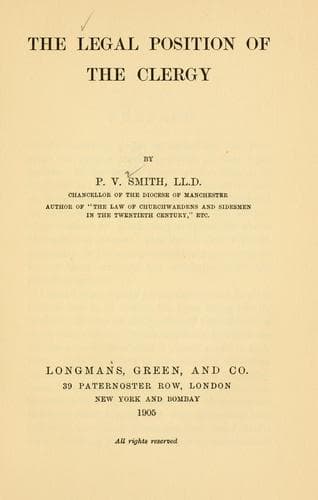
The Legal Position of the ClergySmith, Philip Vernon
Religion
The Legal Position of the Clergy
Smith, Philip Vernon
Canon law; Clergy -- Legal status, laws, etc. -- Great Britain; Ecclesiastical law -- Great Britain
(_c_) Subsection (3) of the same section also makes invalid any
agreement to exercise patronage in favour of or on the nomination of a
particular person, and also, in connection with the transfer of an
advowson, any agreement (i.) to retransfer the advowson; (ii.) to
postpone payment of any part of the purchase money, or to pay interest
until a vacancy in the living, or for more than three months; (iv.) to
make any payment in respect of the date at which the vacancy may occur;
or (v.) that the living shall be resigned in favour of any person. If
the patron of a benefice is a Roman Catholic, the University of Oxford
or of Cambridge has the right to present.[42] A Jew who owns an advowson
may present; but if a Jew holds an office under the Crown to which a
right of presentation is attached, the right passes to the Archbishop of
Canterbury.[43]
3. Every clerk in priest's orders, who has not relinquished the rights
and privileges attaching to those orders under the Clerical Disabilities
Act, 1870,[44] or become incapable of holding preferment under the
Clergy Discipline Act, 1892,[45] is qualified to be appointed to a
benefice. But, unless he has been so ordained by a bishop of the Church
of England or of the Church of Ireland, or by a commissary of an English
bishop under 15 & 16 Vict. c. 52, he is subject to the provisions of the
Colonial Clergy Act, 1874,[46] or, if ordained in Scotland, of the
Episcopal Church (Scotland) Act, 1864,[47] as to the previous consent or
licence of the archbishop of the province or bishop of the diocese; and
a clerk ordained priest as an alien or for service in the colonies under
the Ordination of Aliens Act, 1784, or the Ordinations for Colonies Act,
1819, is subject to the same provisions.[48] The bishop may, however,
independently of the Benefices Act, 1898, refuse to admit him on the
ground of insufficient learning,[49] or of vicious conduct, heresy, or
offences against ecclesiastical law in matters of ritual--anything, in
short, which, if it occurred after admission, might be a ground for
depriving him of the benefice.[50] And, under sect. 2 of that Act, the
bishop may do so, (_a_) if at the date of the vacancy not more than a
year has elapsed since a transfer within the purview of sect. 1[51] of
the right of patronage of the benefice, unless the transfer is proved
not to have been effected in view of the probability of a vacancy within
the year; or (_b_) if not more than three years have elapsed since the
presentee was ordained deacon; or (_c_) if the presentee is unfit owing
to physical or mental infirmity, serious pecuniary embarrassment, grave
misconduct, or neglect of duty in an ecclesiastical office, evil life,
or scandal caused by his moral conduct since ordination; or (_d_) if he
has, with reference to the presentation, been knowingly party or privy
to a transaction or agreement invalid under the Act.[51] The 39th Canon
lays down that a bishop shall not institute to a benefice a clergyman
Public-domain text, read in full here on John Shaqi.
Reviews
Reviews
No reviews yet
Be the first to share your thoughts on this work.
Join the Discussion
Join the discussion
Sign in to leave a comment or review.
Sign InorCreate an account