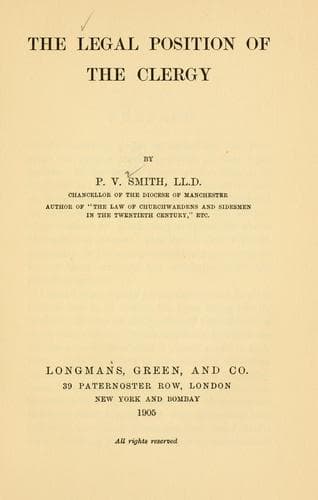
The Legal Position of the ClergySmith, Philip Vernon
Religion
The Legal Position of the Clergy
Smith, Philip Vernon
Canon law; Clergy -- Legal status, laws, etc. -- Great Britain; Ecclesiastical law -- Great Britain
who has been ordained by another bishop, without production of his
letters of orders and a sufficient testimony of his former good life and
behaviour if the bishop requires it,[52] and his appearing on due
examination to be worthy of his ministry. What this examination covers
is not clearly definable; but it has not such a wide scope as the
examination contemplated in Canon 48, which does not apply to presentees
to livings.[53] Under the 95th Canon a bishop is allowed twenty-eight
days for inquiry as to the fitness of a presentee; but this is merely
directory, and he is not precluded from continuing the inquiry after
their expiration.[54]
4. If a bishop refuses to admit a presentee on a ground specified in
sect. 2 of the Act of 1898, or on account of any other unfitness or
disqualification sufficient in law, not having reference to doctrine or
ritual, he is to signify in writing his refusal, and the ground for it,
to the patron and the presentee; and either of them may within one month
thereafter require that the matter be heard by a court consisting of the
archbishop of the province (or if it was the archbishop who refused to
admit, the archbishop of the other province) and a judge of the Supreme
Court, nominated by the Lord Chancellor. The judge is to decide all
questions of law and fact, and if the judge finds that there is no fact
sufficient in law to constitute unfitness or disqualification, the
archbishop is to direct the admission of the presentee. But if the judge
finds that such fact does exist, the archbishop is to decide whether the
presentee is actually in consequence unfit to serve the benefice, and
adjudge whether admission ought under the circumstances to be refused.
In either case his judgment is to be final.[55] When the bishop has
refused to admit a presentee, the patron cannot present him again in
respect of the same vacancy.[56] If the bishop refuses to admit the
presentee of a clerical patron and the refusal is upheld by the court,
the patron has the same right of further presentation as if he were a
lay patron.[57] If a bishop refuses to admit a presentee on the ground
of doctrine or ritual, the old alternative remedies remain, either (_a_)
of a suit of _duplex querela_ by the presentee in the ecclesiastical
court of the province, or (_b_) of an action of _quare impedit_ by the
patron in the High Court of Justice.[58]
Public-domain text, read in full here on John Shaqi.
Reviews
Reviews
No reviews yet
Be the first to share your thoughts on this work.
Join the Discussion
Join the discussion
Sign in to leave a comment or review.
Sign InorCreate an account