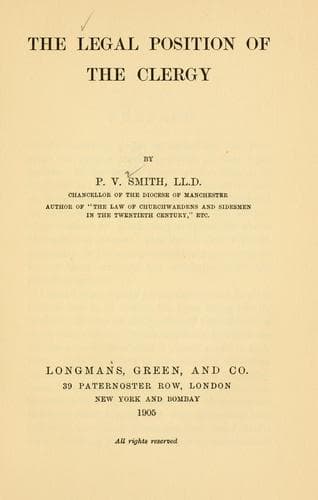
The Legal Position of the ClergySmith, Philip Vernon
Religion
The Legal Position of the Clergy
Smith, Philip Vernon
Canon law; Clergy -- Legal status, laws, etc. -- Great Britain; Ecclesiastical law -- Great Britain
10. Speaking generally, and with the exceptions and under the
restrictions to be presently mentioned, the incumbent and clergymen
permitted by him have the sole right of ministering within his parish;
and a clergyman who intrudes and performs any clerical function in it
without his permission, commits an ecclesiastical offence.[70] But the
bishop, as the chief pastor, has the right to officiate in any church
and parish within his diocese whenever he pleases. And an incumbent
cannot authorise another clergyman to officiate in his church or parish
without the licence of the bishop; but this rule has been held not
applicable in its absolute strictness to merely occasional and isolated
acts of ministration.[71] The few cases in which two or more incumbents
have had the cure of souls within the same parish, have been dealt with
by recent legislation.[72] The 28th and 57th Canons prohibited the
practice of persons leaving their own parish church and communicating or
causing their children to be baptized elsewhere. But this prohibition is
not now in force; and by a general understanding and comity, especially
in towns subdivided into several ecclesiastical parishes, not only do
Church people frequent at will the particular church which they prefer,
but the incumbent of that church pays spiritual visits in sickness and
at other times to regular members of his congregation who reside in
another parish.
11. The ministrations of the incumbent himself are restricted by Canon
71, under which, except where a person is prevented from going to church
by infirmity or sickness, no minister may preach or administer the Holy
Communion in any private house in which there is not a chapel dedicated
and allowed by the ecclesiastical law of the realm, nor, where there is
such a chapel, in any other place but the chapel, and even there only
seldom on Sundays and holy-days in order that the lord or master of the
house and his family may at other times resort to their own parish
church and there receive the Holy Communion at least once every year. An
incumbent can perform Divine service in any consecrated building in his
parish without a licence from the bishop; but, strictly speaking, he
requires the bishop's licence to authorise him to do so in any
unconsecrated building, whether within or outside his parish, or
anywhere in another diocese; and a bishop can inhibit an incumbent of
his diocese from officiating within the diocese elsewhere than in the
consecrated buildings within his own parish. If an incumbent
transgresses in any of these respects he is liable to be sued for an
ecclesiastical offence.[73] Moreover, strangely enough, the Acts which
legalised the worship of Dissenters not only withdrew them from the care
of the incumbent of the parish but also restricted his action among
Church people. For these Acts prohibited any meeting for Protestant
religious worship of more than twenty persons, besides the family and
Public-domain text, read in full here on John Shaqi.
Reviews
Reviews
No reviews yet
Be the first to share your thoughts on this work.
Join the Discussion
Join the discussion
Sign in to leave a comment or review.
Sign InorCreate an account