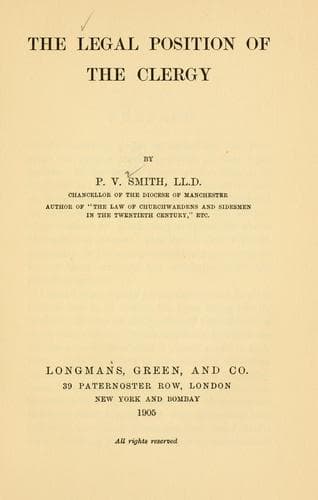
The Legal Position of the ClergySmith, Philip Vernon
Religion
The Legal Position of the Clergy
Smith, Philip Vernon
Canon law; Clergy -- Legal status, laws, etc. -- Great Britain; Ecclesiastical law -- Great Britain
servants of the house where it was held, except at a place duly
certified for the purpose.[74] But in 1855 it was enacted that these
prohibitions should not apply to any assembly for religious worship
either (_a_) conducted by the incumbent or curate in charge of the
parish or any person authorised by him, or (_b_) meeting in private
premises, or (_c_) meeting occasionally in a building not usually
appropriated to religious worship.[75]
12. There are also special cases in which the right of an incumbent to
officiate and exercise the cure of souls is actually superseded in
favour of a chaplain appointed without his consent. Where a nobleman has
a chapel within or attached to his residence he has the right to appoint
a chaplain to serve it.[76] The chapels of public and endowed schools
under the Acts of 1868 and 1869 are free from the jurisdiction and
control of the incumbent of the parish in which they are situate.[77]
Moreover, a bishop may license a clergyman to administer the Lord's
Supper and perform services other than the solemnisation of marriage,
and, subject to the direction of the ordinary, to dispose of the
offertory and collections, in the chapel of any college, school,
hospital, asylum, or public or charitable institution within his
diocese; and where this is done, the institution and chapel are
withdrawn from the cure of souls and control of the incumbent of the
parish.[78] During the eighteenth and first part of the nineteenth
century, before the Church Building and New Parishes Acts had afforded
facilities for creating new parishes, unconsecrated proprietary chapels
were built in various places, with the consent of the bishop of the
diocese and incumbent of the parish, to meet the wants of overgrown town
populations. These chapels can only be served by ministers acting under
the licence of the bishop, (which he can at any time revoke),[79] and
with the consent of the incumbent, which, though he cannot himself
revoke it, is not binding on his successors.[80] Unless the incumbent
waives the right to the alms collected in the chapel, they must be
accounted for to him. The chapel is private property, and no one can
claim to attend it as of right.[81]
13. The right to the cure of souls in a parish naturally carries with it
the right of the incumbent to a voice in the erection of a new church in
the parish and the severance of any portion of the parish from his
benefice and its formation into a new ecclesiastical district or parish.
The various modes in which these objects may be effected are mentioned
in the note to Ch. I. § 6 above. The enactments on the subject provide
opportunities for the incumbents of the existing parishes, which would
be affected by any contemplated action in the matter, to lay their views
and objections, if any, before the bishop and the Ecclesiastical
Commissioners; but their views need not necessarily be accepted and
their objections may be overruled.
Public-domain text, read in full here on John Shaqi.
Reviews
Reviews
No reviews yet
Be the first to share your thoughts on this work.
Join the Discussion
Join the discussion
Sign in to leave a comment or review.
Sign InorCreate an account