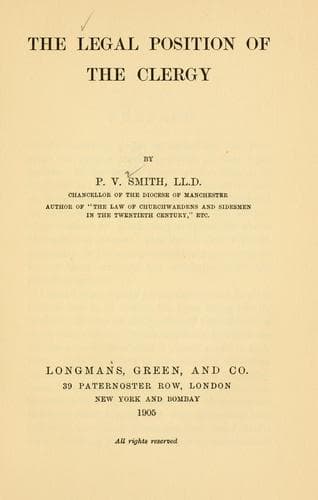
The Legal Position of the ClergySmith, Philip Vernon
Religion
The Legal Position of the Clergy
Smith, Philip Vernon
Canon law; Clergy -- Legal status, laws, etc. -- Great Britain; Ecclesiastical law -- Great Britain
14. An incumbent cannot hold more than one benefice at the same time,
except that upon a certificate of the bishop as to the facts, and with a
licence or dispensation from the archbishop of the province (from the
refusal of which there is an appeal to the King in Council), he may hold
a second, the church of which is within four miles of that of the first
by the nearest road, if the annual value of one of the benefices does
not exceed the net sum of £200, after deducting rates, taxes, tenths,
dues, and permanent charges, but not the stipend of a curate. But where
the population of one of the parishes is over 3000, the joint holding
will only be lawful if that of the other is under 500.[82]
15. The bishop is invested with certain specific powers in case of the
inadequate performance of the ecclesiastical duties of a benefice,
including not only the regular and due performance of Divine service on
Sundays and holy days at the usual hours, but also all such duties as
the incumbent is bound by law to perform, or the performance of which
was solemnly promised by him at his ordination,[83] and the performance
of which has been required of him in writing by the bishop; and
including also, in the four Welsh dioceses and the county of Monmouth,
such ministrations in Welsh as the bishop directs to be performed by
him, not being more than one service in Welsh on every Sunday in any
church, and without interfering with due provision for the
English-speaking portion of the people. If the bishop has reason to
believe that these duties are inadequately performed by an incumbent, he
may issue a commission of inquiry to four commissioners, viz. the
archdeacon or rural dean of the archdeaconry or deanery in which the
benefice is situate; the canon residentiary, prebendary, or honorary
canon of the cathedral church of the diocese elected triennially for the
purpose by the dean and chapter; the beneficed clergyman elected
triennially for the purpose by and out of the beneficed clergy of the
archdeaconry; and a lay justice of the peace of the county nominated on
the requisition of the bishop by the chairman of quarter sessions or
lord-lieutenant of the county; and the incumbent may, if he desires, add
a beneficed clergyman of the diocese or a justice of the peace as a
fifth commissioner. If the commissioners or a majority of them report
that the duties are inadequately performed, the procedure may be
different, according as they do or do not add that this is due to the
negligence of the incumbent. If they do not report negligence, the
bishop has only power to require the incumbent to nominate one or more
curates to perform or assist in performing the duties, and to make the
appointment himself if the incumbent fails to do so, subject to an
appeal to the archbishop.[84] But if they report negligence, the bishop
may make the appointment without previously requiring the incumbent to
nominate, and may inhibit the incumbent from performing all or any of
Public-domain text, read in full here on John Shaqi.
Reviews
Reviews
No reviews yet
Be the first to share your thoughts on this work.
Join the Discussion
Join the discussion
Sign in to leave a comment or review.
Sign InorCreate an account