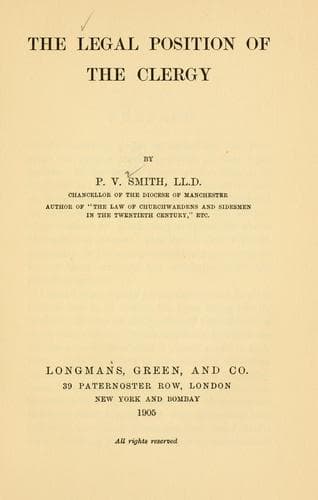
The Legal Position of the ClergySmith, Philip Vernon
Religion
The Legal Position of the Clergy
Smith, Philip Vernon
Canon law; Clergy -- Legal status, laws, etc. -- Great Britain; Ecclesiastical law -- Great Britain
the duties, subject to an appeal by him to the tribunal constituted by
the Benefices Act, 1898.[85] Evidence given before the commissioners is
privileged.[86]
16. An incumbent is ordinarily bound to reside in his benefice, or in
one of them if he holds two, or in the parsonage or vicarage house (if
any);[87] and, even though he keeps a curate, it is his duty, unless
excused for some valid reason by the bishop, to read the prayers and
administer the sacraments at least once a month.[88] If he is absent in
any year more than 90 days altogether, he is liable to forfeit, by way
of penalty, one-third; if more than 180 days, one-half; if more than 240
days, two-thirds; and, if for the whole time, three-fourths of the
year's income of the benefice; unless he has the bishop's licence, or if
the bishop has refused it, the archbishop's licence, for
non-residence.[89] This licence may be granted on account of (i.)
mental or physical infirmity; (ii.) the dangerous illness of the
incumbent's wife or child residing with him (but in that case for six
months only, renewable from time to time by leave of the archbishop on
the recommendation of the bishop); (iii.) the absence or unfitness of a
house of residence; (iv.) the occupation by the incumbent of a house of
his own in the parish, provided he keeps the house of residence in good
repair.[90] Exceptions are made in favour of incumbents holding certain
official positions;[91] and the bishop, with the sanction of the
archbishop, may grant a licence to reside outside the benefice, where he
thinks it expedient so to do. A licence for non-residence is only valid
until the 31st of December in the year next after that in which it was
granted; and it may at any time be revoked, subject, in the case of a
bishop's licence, to an appeal to the archbishop.[92]
17. In lieu of or after proceeding for pecuniary penalties, the bishop
may issue a monition and order requiring a non-resident incumbent to
reside on and perform the duties of his benefice, and in case of
non-compliance with the order may, subject to an appeal to the
archbishop, sequester the revenues of the benefice until residence is
resumed, and direct their application in payment of the penalties, the
expenses of the monition and sequestration, the repair and upkeep of
the chancel, house of residence, and other property of the benefice, the
satisfaction of any creditor's sequestration, and the augmentation or
improvement of the benefice or its property, allowing, if he pleases, a
certain proportion to the incumbent.[93] If a benefice continues for a
year under sequestration for non-residence or an incumbent incurs two
sequestrations for non-residence within two years, and is not relieved
in respect of either on appeal, it becomes void as if the incumbent were
dead.[94]
Public-domain text, read in full here on John Shaqi.
Reviews
Reviews
No reviews yet
Be the first to share your thoughts on this work.
Join the Discussion
Join the discussion
Sign in to leave a comment or review.
Sign InorCreate an account