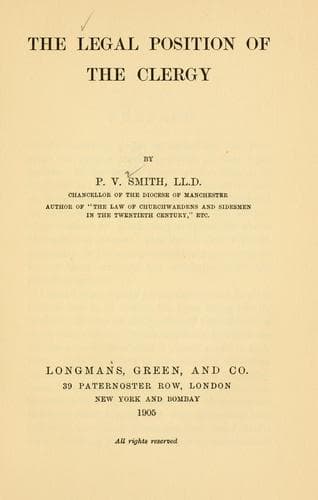
The Legal Position of the ClergySmith, Philip Vernon
Religion
The Legal Position of the Clergy
Smith, Philip Vernon
Canon law; Clergy -- Legal status, laws, etc. -- Great Britain; Ecclesiastical law -- Great Britain
18. The law also makes provision for the performance of the
ecclesiastical duties of a benefice by curates in the case of an
incumbent who does not reside thereon for nine months in each year and
does not with the consent of the bishop perform the ecclesiastical
duties while residing on another benefice of which he is the incumbent,
or while holding a licence not to reside on the benefice or not to
reside in the parsonage house thereof.[95]
19. Incumbents who are non-resident with the bishop's licence cannot
without the bishop's permission resume the duties of their benefice
before the expiration of their licence; nor can they, if non-resident
for more than twelve months, interfere during that period with the
curate entrusted with those duties by the bishop.[96]
20. In reckoning the periods prescribed by law as to non-residence, a
month is a calendar month, except where it is to be made up of an
aggregate of lesser periods, in which case thirty days are to be deemed
a month. A year is to be reckoned as commencing on January 1, and ending
on the following December 31, both inclusive.[97]
21. An incumbent vacates his benefice by (i.) death, (ii.) resignation,
(iii.) admission to other preferment which he cannot by law hold
therewith, or (iv.) deprivation.
22. Resignation must be tendered to the bishop, and unless made in view
of an exchange must be unconditional. It should be made either in person
or by a deed attested by two witnesses. The presence and attestation of
a notary in addition are usual but are not essential. The resignation
may be made at the request of the bishop to avoid scandal and legal
proceedings, and he may agree to postpone the declaration of the vacancy
to a fixed date in the future in order to enable the incumbent to
receive the tithe rentcharge accruing before that date. Its acceptance
by the bishop need not be signified in any particular form or even in
writing, and is implied if the resignation was tendered at the bishop's
request. It cannot be revoked after its acceptance by the bishop.
Whether it can, under any circumstances, be revoked previously to
acceptance by him is not clear.[98] If, however, it is made for the
purpose of an exchange, it does not take effect unless the exchange is
carried out; so that if either of the exchanging incumbents dies before
being inducted to his new living, both resignations are void, as well as
the institution and induction of the other to the deceased's old living,
if that has taken place.[99] The Benefices Act, 1898, precludes an
incumbent, when he is presented, from entering into any engagement for
resigning the benefice except under the Clergy Resignation Bonds Act,
1828, sects. 1, 2, which allow such an engagement with a view to the
appointment to the benefice, when resigned, of a single specified
individual whomsoever, or of one of two specified individuals, each of
whom is by blood or marriage an uncle, son, grandson, brother, nephew,
Public-domain text, read in full here on John Shaqi.
Reviews
Reviews
No reviews yet
Be the first to share your thoughts on this work.
Join the Discussion
Join the discussion
Sign in to leave a comment or review.
Sign InorCreate an account