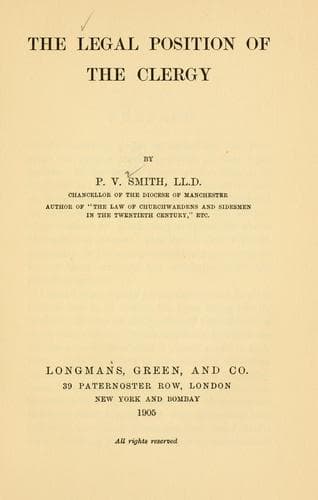
The Legal Position of the ClergySmith, Philip Vernon
Religion
The Legal Position of the Clergy
Smith, Philip Vernon
Canon law; Clergy -- Legal status, laws, etc. -- Great Britain; Ecclesiastical law -- Great Britain
or great-nephew of the person or one of the persons entitled in equity
to the patronage of the benefice, or of a married woman whose husband is
in her right the patron or one of the patrons.[100] The corrupt taking
of any pension money or other benefit for the resignation or exchange of
a benefice is prohibited by 31 Eliz. c. 6, s. 7. But under the
Incumbents Resignation Acts, 1871 and 1887, a pension may be awarded out
of the revenue of the benefice to an incumbent who, after a continuous
holding of the benefice for not less than seven years, retires therefrom
on the ground of incapacity to perform the duties by reason of permanent
mental or bodily infirmity. The bishop, if he thinks fit, on the
representation of the incumbent, appoints a commission to inquire and
report as to the expediency of the resignation, and, if the majority of
the commissioners consider it expedient, as to the amount of the
pension; which must not exceed one-third of the net annual value of the
benefice, exclusive of the house of residence. If the patron refuses
consent to the resignation, the question of its acceptance is to be
decided by the archbishop. If the incumbent is a lunatic, found such by
inquisition or certificate of a master of lunacy, the resignation may be
carried out in his name by the committee of his estate; but no provision
exists for effecting the resignation of an incumbent of unsound mind,
not so found. If any part of the income of the benefice is derived from
tithe rentcharge or glebe lands, the pension is to vary like the tithe
rentcharge with the corn averages; but it will not otherwise be affected
by a change in the value of the benefice.[101] It will cease if the
pensioner relinquishes the rights and privileges of holy orders under
the Clerical Disabilities Act, 1870, or is admitted to another benefice;
and if he undertakes clerical duties for a remuneration elsewhere than
in the benefice which he resigned, the bishop may decide that his
pension shall cease or be diminished altogether or for a limited time;
and the archbishop, on appeal, may confirm, annul, or vary the bishop's
decision.[102] A sum due from the retiring incumbent to his successor
for dilapidations may be deducted out of the pension, so that the
deductions do not without the bishop's consent exceed in any year
one-half of the pension; but no other debt can be set off against
it.[103]
23. Except in the case already mentioned of an incompleted
exchange,[104] an incumbent _ipso facto_ vacates his benefice on
admission to another preferment which cannot at law be held with
it.[105]
Public-domain text, read in full here on John Shaqi.
Reviews
Reviews
No reviews yet
Be the first to share your thoughts on this work.
Join the Discussion
Join the discussion
Sign in to leave a comment or review.
Sign InorCreate an account