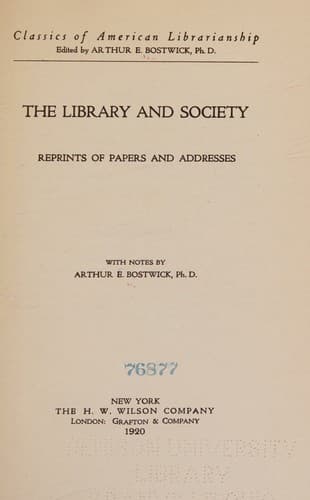
The Library and Society: Reprints of Papers and Addresses
History
The Library and Society: Reprints of Papers and Addresses
Libraries and society; Library science -- Social aspects
The "Gospel of Wealth" but echoes Christ's words. It calls upon the
millionaire to sell all that he hath and give it in the highest and best
form to the poor, by administering his estate himself for the good of
his fellows, before he is called upon to lie down and rest upon the
bosom of Mother Earth. So doing, he will approach his end no longer the
ignoble hoarder of useless millions, poor, very poor indeed, in money,
but rich, very rich, twenty times a millionaire still, in the affection,
gratitude and admiration of his fellow-men, and--sweeter far--soothed
and sustained by the still small voice within, which, whispering, tells
him that, because he has lived, perhaps one small part of the great
world has been bettered just a little. This much is sure: against such
riches as these no bar will be found at the gates of Paradise.
THE IDEA OF A POPULAR LIBRARY
The following seven papers give some fundamental ideas on
the functions of popular libraries. They are arranged in
chronological order, and, so grouped, span the gap between
1851 and 1906, considerably more than half a century. The
first is interesting as presenting a discussion at the
inception of our first great public library, that of the
city of Boston, quoted from "The Life, Letters and Journals
of George Ticknor" (Boston, 1909). Ticknor's idea of a
popular library, given in a letter to Edward Everett, is
followed by Everett's answer. Some of the editor's comments
precede and conclude. Those interested may read on, in
Chapter XV, Vol. II of the "Life," and get a further idea of
Ticknor's zeal in promoting the Boston library and his
interest in making it as popular as possible, in distinction
to the idea of a library solely for scholars, upheld by John
Jacob Astor, in his New York gift of three years previous,
which Everett rather favored.
George Ticknor was born in Boston, Aug. 1, 1791 and
graduated at Dartmouth in 1807. He was admitted to the bar
in 1813 but devoted his life chiefly to teaching and to
literature, serving as professor in Harvard in 1819-35. He
died in Boston, Jan. 26, 1871. A sketch of Everett appears
on page 127 of this volume.
The endowment of a great library in New York, given by Mr. John Jacob
Astor, at his death, in 1848, was much talked about; and men of forecast
began to say openly that, unless something of a like character were done
in Boston, the scientific and literary culture of this part of the
country would follow trade and capital to the metropolis, which was thus
taking the lead. Still, nothing effectual was done. Among the persons
with whom Mr. Ticknor had, of late years, most frequently talked of the
matter, Dr. Channing was dead, Mr. Abbott Lawrence had become Minister
to England, and Mr. Jonathan Phillips was growing too infirm to take
part in public affairs. The subject, however, kept its hold on Mr.
Ticknor's mind.
Public-domain text, read in full here on John Shaqi.
Reviews
Reviews
No reviews yet
Be the first to share your thoughts on this work.
Join the Discussion
Join the discussion
Sign in to leave a comment or review.
Sign InorCreate an account