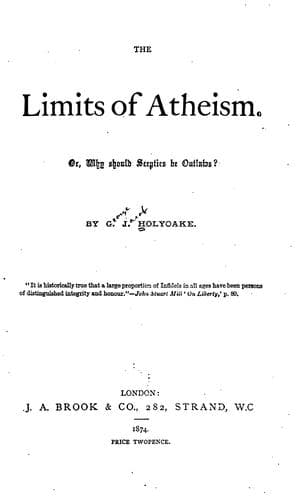
The Limits of Atheism; Or, Why Should Sceptics Be Outlaws?Holyoake, George Jacob
Religion
The Limits of Atheism; Or, Why Should Sceptics Be Outlaws?
Holyoake, George Jacob
Atheism
Infidelity is a term I detest. It implies that you believe enough to
subject you to reproach, and disbelieve enough to entitle you to be
damned. It signifies disbelief too inveterate to allow you to go back to
superstition, and too much timidity to carry your doubt to a definite
or legitimate result. I am for thoroughness and decision. If it be
criminality to disbelieve, I will put scepticism far from me. I will
not even tamper with doubt. But if it be lawful to reject from the
understanding whatever seems false, then I will disbelieve error as a
duty, and unhesitatingly doubt whatever is doubtful.
Atheism--objectionable as it is from wanton negative associations--is a
far more wholesome term. It is a defiant, militant word. There is a ring
of decision about it. There is no cringing in it. It keeps no terms with
superstition. It makes war, and means it. It carries you away from the
noisome word-jugglery of the conventional pulpits, and brings you face
to face with nature. It is a relief to get out of the crowd who believe
because their neighbours do, who pray by rote, and worship through fear;
and win your liberty to wander in the refreshing solitude where the
heart may be honest, and the intellect free. Affirmative Atheism of the
intellect is a proud, honest, intrepid, self-respecting attitude of the
mind. The Negative Atheism of mere ignorance, of insensibility, of
lust, and gluttony, and drunkenness, of egotism or vanity, whose talk
is outrage, and whose spirit is blasphemy; this is the gross negation
of God, which superstition begets in its slavery, and nurtures by
its terrors. These species of Atheism I recognise only to disown and
denounce them. Of these the priest is the author who preaches the
natural corruption of the human heart, who inculcates the guilt of
Freethought, the distrust of reason, and despair of self-reliant
progress. Utterly different from this is the Atheism of reflection,
which seeks for conclusive evidence, which listens reverentially for
the voice of God, which weighs carefully the teachings of a thoughtful
Theism; but refuses to recognise the officious, incoherent babblement of
intolerant or presumptuous men. Reflective Atheism is simply a reluctant
uncertainty as to the consciousness of Nature, or as to the existence
of a Power over Nature. As one who will allow me the pleasure of
calling him my friend, Mr. G. H. Lewes, said, all reflective Atheism is
suspensive.
He invented the phrase Suspensive Atheism to describe the only form of
opinion which he knew I maintained. The thoughtful Atheist wishes to
perceive the whole truth of Nature, he hesitates unwillingly, and waits
longingly for more light.
Let us dismiss at once that crude and evasive state which affects
Atheism, and, at the same time, denies it; which says no Theist has
defined Deity, and therefore the disbelief in it is an impossibility.
Public-domain text, read in full here on John Shaqi.
Reviews
Reviews
No reviews yet
Be the first to share your thoughts on this work.
Join the Discussion
Join the discussion
Sign in to leave a comment or review.
Sign InorCreate an account