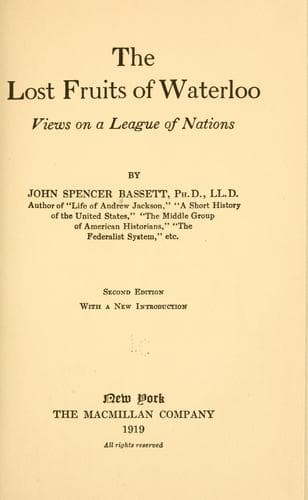
International cooperation; Peace; World War, 1914-1918
Turning to the subject with which we are here chiefly concerned, it
is interesting to note that Germany has undertaken in the last years
to carry forward her world expansion by methods that are entirely
different. While she has federated in industrial life she appears in
her foreign relations as a true representative of the spirit that
built up the trusts. She means to unify her competitor states, not as
she has united her industries, but as the American trusts secured the
whole field of operations. First she forms a small group with herself
at the head. In the group are Germany, Austria, Turkey, and, later on,
Bulgaria. At this stage of her progress she has gone as far as the
Standard Oil Company had gone when Mr. Rockefeller had perfected the
idea of the “trust” in 1882. Her next step was to attack her rivals.
France she would crush at a blow, first lulling Great Britain to
inactivity by feigned friendship and the promise of gains in the Near
East. Then she would do what she would with Russia. With these two
nations disposed of, Britain, the unready, could be easily brought to
terms, and the United States would then be at her mercy. The mass of
German people had not, perhaps, reasoned the process out in this way;
but it was so easily seen that it could not have escaped the minds of
the leaders of the German military party. No trust builder ever made
fairer plans for the upbuilding of his enterprise than these gentlemen
made for putting through their combination, before which they saw in
their minds the states of the world toppling. So well were the plans
made and so efficient were the strokes that the utmost efforts of the
rest of the world have become necessary to defeat the German hopes.
The United States have approached the problem of world relations in
another spirit. Rejecting the spirit of the trust magnate, which
Germany accepted, we have turned to coöperation as the means of
avoiding international competition and distrust. President Wilson’s
repeated suggestions of a federated peace are couched in the exact
spirit of the cartel. He asks that war may be replaced by coöperation,
pointing out the tremendous advantage to all if the machinery of
competition can be discarded.
Viewed in its largest aspects, therefore, the present struggle has
resolved itself into a debate over the amount of unity that shall in
the future exist between states. It does not seem possible that Austria
will ever be a thoroughly sovereign state again, nor that Turkey will
escape from the snare in which her feet are caught. What degree of
unity this will engender between France and Great Britain, if the old
system of international relations continues, it is not hard to guess.
And as for the small states of Europe, their future is very perplexing.
Public-domain text, read in full here on John Shaqi.
Reviews
Reviews
No reviews yet
Be the first to share your thoughts on this work.
Join the Discussion
Join the discussion
Sign in to leave a comment or review.
Sign InorCreate an account