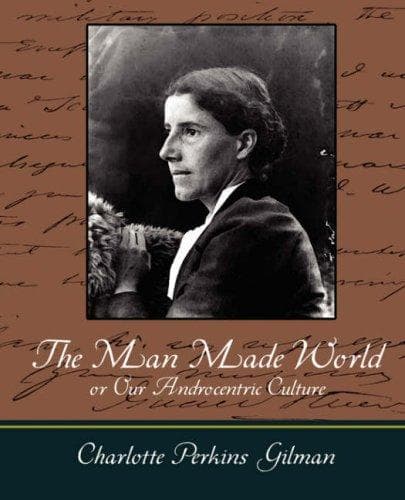
The Man-Made World; Or, Our Androcentric CultureGilman, Charlotte Perkins
General
The Man-Made World; Or, Our Androcentric Culture
Gilman, Charlotte Perkins
Women -- Social and moral questions; Women -- Social conditions
To the same source we trace the social and educational limitations
set about women. The dominant male, holding his women as property,
and fiercely jealous of them, considering them always as _his,_ not
belonging to themselves, their children, or the world; has hedged them
in with restrictions of a thousand sorts; physical, as in the crippled
Chinese lady or the imprisoned odalisque; moral, as in the oppressive
doctrines of submission taught by all our androcentric religions;
mental, as in the enforced ignorance from which women are now so swiftly
emerging.
This abnormal restriction of women has necessarily injured motherhood.
The man, free, growing in the world's growth, has mounted with the
centuries, filling an ever wider range of world activities. The
woman, bound, has not so grown; and the child is born to a progressive
fatherhood and a stationary motherhood. Thus the man-made family reacts
unfavorably upon the child. We rob our children of half their social
heredity by keeping the mother in an inferior position; however
legalized, hallowed, or ossified by time, the position of a domestic
servant is inferior.
It is for this reason that child culture is at so low a level, and for
the most part utterly unknown. Today, when the forces of education are
steadily working nearer to the cradle, a new sense is wakening of the
importance of the period of infancy, and its wiser treatment; yet those
who know of such a movement are few, and of them some are content to
earn easy praise--and pay--by belittling right progress to gratify the
prejudices of the ignorant.
The whole position is simple and clear; and easily traceable to
its root. Given a proprietary family, where the man holds the woman
primarily for his satisfaction and service--then necessarily he shuts
her up and keeps her for these purposes. Being so kept, she cannot
develop humanly, as he has, through social contact, social service, true
social life. (We may note in passing, her passionate fondness for the
child-game called "society" she has been allowed to entertain herself
withal; that poor simiacrum of real social life, in which people
decorate themselves and madly crowd together, chattering, for what is
called "entertainment.") Thus checked in social development, we have but
a low grade motherhood to offer our children; and the children, reared
in the primitive conditions thus artificially maintained, enter life
with a false perspective, not only toward men and women, but toward life
as a whole.
Public-domain text, read in full here on John Shaqi.
Reviews
Reviews
No reviews yet
Be the first to share your thoughts on this work.
Join the Discussion
Join the discussion
Sign in to leave a comment or review.
Sign InorCreate an account