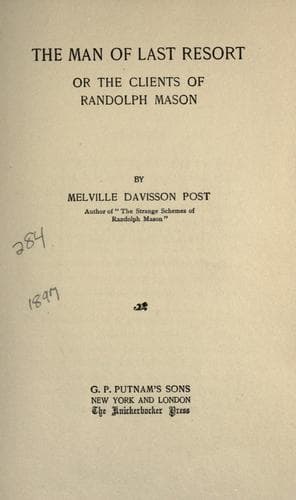
The Man of Last Resort; Or, The Clients of Randolph MasonPost, Melville Davisson
General
The Man of Last Resort; Or, The Clients of Randolph Mason
Post, Melville Davisson
American fiction -- 19th century; Detective and mystery stories, American; Legal stories, American
Is there not in all this criticism a faint suggestion of the men who
“darken counsel by words without knowledge”?
Lycurgus taught the laws to the people, Solon taught the laws to the
people. The Roman law provided for a final appeal from the consul to
the people, and the very essence of republican institutions lies, as
has been said, in a recognition of the people as the source of the
law-making power. If the law offers imperfect security and is capable of
revision, the people must be taught in order that they may revise it. If
it offers insufficient security and is incapable of revision, then the
people must be taught in order that they may protect themselves. This
conclusion is irresistible. To counsel otherwise is to share in the
odium of that short-sighted ambassador who urged upon Pericles the
wisdom of reversing the tablet upon which the law was written in order
that the people might not read the decree.
Surely, then, he who points out the vices of the law to the people
cannot be said to do evil, unless the law of the land is to be made by
a narrow patriciate sitting, like the Areopagus of ancient Athens, with
closed doors.
That yesterday in which the enemies of society plied their craft by
means of the jimmy and the dark lantern is now almost entirely past. The
master rogue has discovered, with immense satisfaction, that the labor
of others may be enjoyed, and the results of their labor seized and
appropriated to his uses, without thrusting himself within the control
of criminal tribunals.
Wise magistrates, laboring for the welfare of the race, have been
pleased to write down what should be done and what should not be done,
and have called it “law.” The citizen, having no time to inquire, has
gone about his trade under the impression that these rules were offering
ample protection to his person and his property. But the law, being
of human device, is imperfect, and in this fag end of the nineteenth
century, the evil genius thrusts through and despoils the citizen,
and the robbery is all the more easy because the victim sleeps in a
consciousness of perfect security.
The writer has undertaken to point out a few of the more evident
inadequacies of the law and a few of the simpler methods for evasion
that are utilized by the skilful villain. It must be borne in mind,
however, that more gigantic and more intricate methods for evading the
law and for appropriating the property of the citizen are available.
The unwritten records of business ventures and the reports of courts
are crowded with the record of huge schemes having for their ultimate
purpose the robbery of the citizen. Some of these have been successful
and some have failed. Enough have brought great fortunes to their daring
perpetrators to appal that one who looks on with the welfare of human
society at heart.
Public-domain text, read in full here on John Shaqi.
Reviews
Reviews
No reviews yet
Be the first to share your thoughts on this work.
Join the Discussion
Join the discussion
Sign in to leave a comment or review.
Sign InorCreate an account