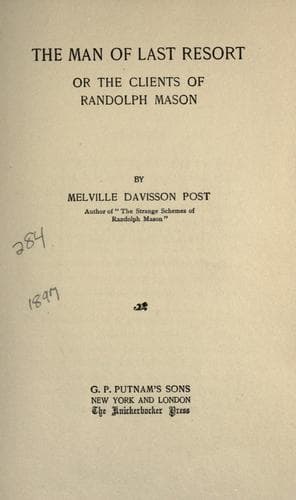
The Man of Last Resort; Or, The Clients of Randolph MasonPost, Melville Davisson
General
The Man of Last Resort; Or, The Clients of Randolph Mason
Post, Melville Davisson
American fiction -- 19th century; Detective and mystery stories, American; Legal stories, American
“The facts herewith concerned are involved in no controversy, and
the agreement being couched in plain terms, admits of no doubtful
construction. It would seem that the defendant Hergan called at the
gambling house of one Crawley, a resident of this State, and requested a
private interview with the said Crawley and the plaintiff; that in this
interview Hergan explained that he was considering what it pleased him
to denominate 'a gambling venture in oil,' and solicited the two men to
join him in the venture. This they declined to do, but suggested
that they would advance to Hergan such money as he might need upon a
promissory note with good security.
“It appears that some controversy arose as to the rate of interest to be
paid; and a division of the profits was suggested in lieu of the larger
per cent. This matter was finally concluded by the plaintiff and the
said Crawley advancing the said sum, and taking therefor the note filed
in this cause, and in addition thereto entering into this agreement in
writing with the said Hergan, wherein it is set forth that the money
loaned is to be used by the said Hergan for the express purpose of 'a
gamble in oil,' and for no other purpose; and that if any profit should
result from said gambling venture, the said plaintiff and the said
Crawley were to receive one-eighth of said profits. It seems that the
money was paid and presumably used by Hergan for the purpose as stated.
Afterward the note was presented for payment, and being refused, was
duly protested, and later sued upon in this court.
“It is maintained by the defendants that this transaction was contrary
to public policy, and that the money, having been loaned for a known
illegal purpose, cannot be recovered in a judicial tribunal, but falls
Within the purlieus of those matters which are _par se ex turfe causa_,
and for which the law provides no remedy. On the contrary, it is urged
by counsel for the plaintiff that the transaction as between the parties
to this suit was entirely commercial and innocent; that the plaintiff is
a mere lender of money in a _bona fide_ transaction, and is in no wise
a party to any illegal proceeding, and that the mere use to which the
money was put is a matter of no moment.
“The law, being for the welfare and the protection of human society,
refuses to recognize and enforce certain contracts had among its
citizens, when those contracts are founded in moral turpitude or
inconsistent with the good order or solid interests of society.
“'No people,' declares Chancellor Kent in his _Commentaries_, 'are
bound or ought to enforce or hold valid in their courts of justice any
contract which is injurious to the public rights or offends their morals
or contravenes their policy or violates a public law.' Hence contracts
having an illegal or immoral consideration, or tending to the violation
of law or the debauching of public morals, are held to be _contra bonas
mores_, and are void.
Public-domain text, read in full here on John Shaqi.
Reviews
Reviews
No reviews yet
Be the first to share your thoughts on this work.
Join the Discussion
Join the discussion
Sign in to leave a comment or review.
Sign InorCreate an account