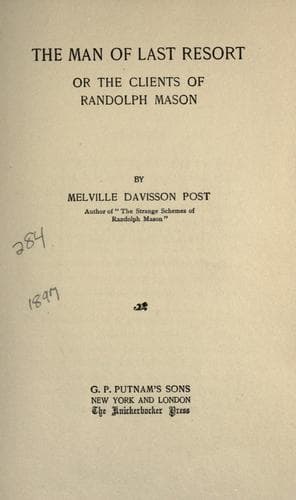
The Man of Last Resort; Or, The Clients of Randolph MasonPost, Melville Davisson
General
The Man of Last Resort; Or, The Clients of Randolph Mason
Post, Melville Davisson
American fiction -- 19th century; Detective and mystery stories, American; Legal stories, American
“It is said that the object of all law is to suppress vice, and to
promote the general welfare of society, and it does not give its
assistance to persons to enforce a demand originating in their breach or
violation of its principles and enactments. It is not necessary that the
law expressly prohibit or enjoin an act. It may impliedly prohibit or
enjoin it. In either case a contract in violation of its principles is
void under the wholesome maxim _ex turpi causa non oritur actio_.
“It may happen, and, indeed, frequently does happen, that the individual
suffers great hurt from this sweeping policy of the law, but it is held
that the good of the commonwealth rises above the mere benefit of the
individual citizen, and that where the welfare of the whole of society
is involved, the law will not pause to consider the injury entailed upon
the mere unit. Hence the policy of government in the exigencies of
war, when protection must be had against violence, and the policy of
government in the peaceful administration of the law, when protection
must be had against vice.
“Thus gambling, wagering, and all gambling and wagering contracts
and transactions are illegal as against public policy, since they are
repugnant to the well-being of society, fraught with vice, pregnant with
demoralization, and corrupting alike to the youth and to the aged, as
they inspire a hope of reward without labor.
“It is significant that in matters of this nature human society has been
progressive. Under the common law of England wagers were not unlawful
or unenforceable, but the statute of 9th Anne followed and altered the
common law, and the statutes of 8th and 9th Victoria altered it yet
farther, and in the United States every separate Commonwealth has its
respective statute striking at this vice.
“I think it will not at this day be denied that all transactions in
stocks, by way of margin, settlement of differences, and payment of
gains or losses, without intending to deliver the stocks, is a gambling
or wagering operation which the law does not sanction, and will not
carry into effect; and it has been held in the Supreme Court of the
United States in the case of Irwin vs. Williar, 'If under the guise of
a contract to deliver goods at a future day the real intent be to
speculate in the rise or fall of prices, and the goods are not to be
delivered, but one party is to pay to the other the difference between
the contract price and the market price of the goods at the date fixed
for executing the contract, the whole transaction is nothing more than
a wager, and is null and void.' And that 'Generally in this country
wagering contracts are held to be illegal and void as against public
policy.'
Public-domain text, read in full here on John Shaqi.
Reviews
Reviews
No reviews yet
Be the first to share your thoughts on this work.
Join the Discussion
Join the discussion
Sign in to leave a comment or review.
Sign InorCreate an account