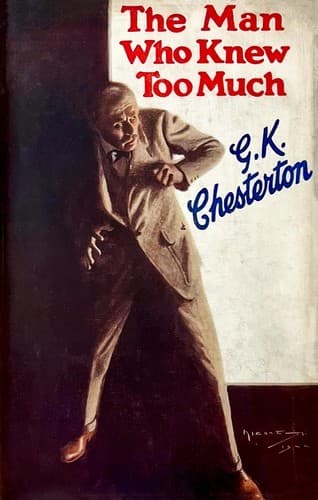
The Man Who Knew Too MuchChesterton, G. K. (Gilbert Keith)
ReligionComparative
The Man Who Knew Too Much
Chesterton, G. K. (Gilbert Keith)
Aristocracy (Social class) -- Fiction; Detective and mystery stories, English; Great Britain -- Fiction
"Hooker Wilson was the first criminal I ever knew, and he was a
policeman," explained Fisher, twirling his wine glass. "And all my
life has been a mixed-up business of the sort. He was a man of very
real talent, and perhaps genius, and well worth studying, both as a
detective and a criminal. His white face and red hair were typical
of him, for he was one of those who are cold and yet on fire for
fame; and he could control anger, but not ambition. He swallowed the
snubs of his superiors in that first quarrel, though he boiled with
resentment; but when he suddenly saw the two heads dark against the
dawn and framed in the two windows, he could not miss the chance,
not only of revenge, but of the removal of the two obstacles to his
promotion. He was a dead shot and counted on silencing both, though
proof against him would have been hard in any case. But, as a matter
of fact, he had a narrow escape, in the case of Nolan, who lived
just long enough to say, 'Wilson' and point. We thought he was
summoning help for his comrade, but he was really denouncing his
murderer. After that it was easy to throw down the ladder above him
(for a man up a ladder cannot see clearly what is below and behind)
and to throw himself on the ground as another victim of the
catastrophe.
"But there was mixed up with his murderous ambition a real belief,
not only in his own talents, but in his own theories. He did believe
in what he called a fresh eye, and he did want scope for fresh
methods. There was something in his view, but it failed where such
things commonly fail, because the fresh eye cannot see the unseen.
It is true about the ladder and the scarecrow, but not about the
life and the soul; and he made a bad mistake about what a man like
Michael would do when he heard a woman scream. All Michael's very
vanity and vainglory made him rush out at once; he would have walked
into Dublin Castle for a lady's glove. Call it his pose or what you
will, but he would have done it. What happened when he met her is
another story, and one we may never know, but from tales I've heard
since, they must have been reconciled. Wilson was wrong there; but
there was something, for all that, in his notion that the newcomer
sees most, and that the man on the spot may know too much to know
anything. He was right about some things. He was right about me."
"About you?" asked Harold March in some wonder.
Public-domain text, read in full here on John Shaqi.
Reviews
Reviews
No reviews yet
Be the first to share your thoughts on this work.
Join the Discussion
Join the discussion
Sign in to leave a comment or review.
Sign InorCreate an account