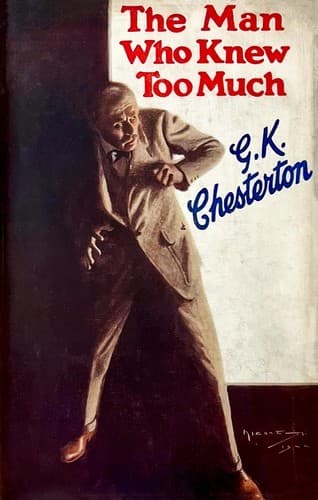
The Man Who Knew Too MuchChesterton, G. K. (Gilbert Keith)
ReligionComparative
The Man Who Knew Too Much
Chesterton, G. K. (Gilbert Keith)
Aristocracy (Social class) -- Fiction; Detective and mystery stories, English; Great Britain -- Fiction
"I am the man who knows too much to know anything, or, at any rate,
to do anything," said Horne Fisher. "I don't mean especially about
Ireland. I mean about England. I mean about the whole way we are
governed, and perhaps the only way we can be governed. You asked me
just now what became of the survivors of that tragedy. Well, Wilson
recovered and we managed to persuade him to retire. But we had to
pension that damnable murderer more magnificently than any hero who
ever fought for England. I managed to save Michael from the worst,
but we had to send that perfectly innocent man to penal servitude
for a crime we know he never committed, and it was only afterward
that we could connive in a sneakish way at his escape. And Sir
Walter Carey is Prime Minister of this country, which he would
probably never have been if the truth had been told of such a
horrible scandal in his department. It might have done for us
altogether in Ireland; it would certainly have done for him. And he
is my father's old friend, and has always smothered me with
kindness. I am too tangled up with the whole thing, you see, and I
was certainly never born to set it right. You look distressed, not
to say shocked, and I'm not at all offended at it. Let us change the
subject by all means, if you like. What do you think of this
Burgundy? It's rather a discovery of mine, like the restaurant
itself."
And he proceeded to talk learnedly and luxuriantly on all the wines
of the world; on which subject, also, some moralists would consider
that he knew too much.
III. THE SOUL OF THE SCHOOLBOY
A large map of London would be needed to display the wild and zigzag
course of one day's journey undertaken by an uncle and his nephew;
or, to speak more truly, of a nephew and his uncle. For the nephew,
a schoolboy on a holiday, was in theory the god in the car, or in
the cab, tram, tube, and so on, while his uncle was at most a priest
dancing before him and offering sacrifices. To put it more soberly,
the schoolboy had something of the stolid air of a young duke doing
the grand tour, while his elderly relative was reduced to the
position of a courier, who nevertheless had to pay for everything
like a patron. The schoolboy was officially known as Summers Minor,
and in a more social manner as Stinks, the only public tribute to
his career as an amateur photographer and electrician. The uncle was
the Rev. Thomas Twyford, a lean and lively old gentleman with a red,
eager face and white hair. He was in the ordinary way a country
clergyman, but he was one of those who achieve the paradox of being
famous in an obscure way, because they are famous in an obscure
world. In a small circle of ecclesiastical archaeologists, who were
the only people who could even understand one another's discoveries,
he occupied a recognized and respectable place. And a critic might
have found even in that day's journey at least as much of the
uncle's hobby as of the nephew's holiday.
Public-domain text, read in full here on John Shaqi.
Reviews
Reviews
No reviews yet
Be the first to share your thoughts on this work.
Join the Discussion
Join the discussion
Sign in to leave a comment or review.
Sign InorCreate an account